Drive-In vs. Push-Back Racking: Which Fits Your Warehouse?
Both systems trade aisles for density. Which one pays off depends on how many SKUs you store, how many pallets each SKU runs deep, and how fast those pallets turn.
This guide is general information, not engineering or legal advice. Requirements vary by jurisdiction and by manufacturer — confirm with a qualified engineer, your rack supplier and your local authority.
Key takeaways
- Drive-in gives the most pallets per square foot and usually the lowest cost per position among high-density systems — but forklifts drive inside the rack, lanes are deep, and it works best with many pallets of few SKUs.
- Push-back keeps forklifts in the aisle, presents a pallet at the face of every lane, and handles more SKUs in the same footprint. It costs more per position and lanes are shorter (typically 2–6 deep).
- Both are last-in, first-out. If you need FIFO, look at drive-through or pallet flow.
- The deciding numbers are your pallets per SKU, how quickly each SKU turns, and how much honeycombed (empty but unusable) space you can tolerate.
How each system works
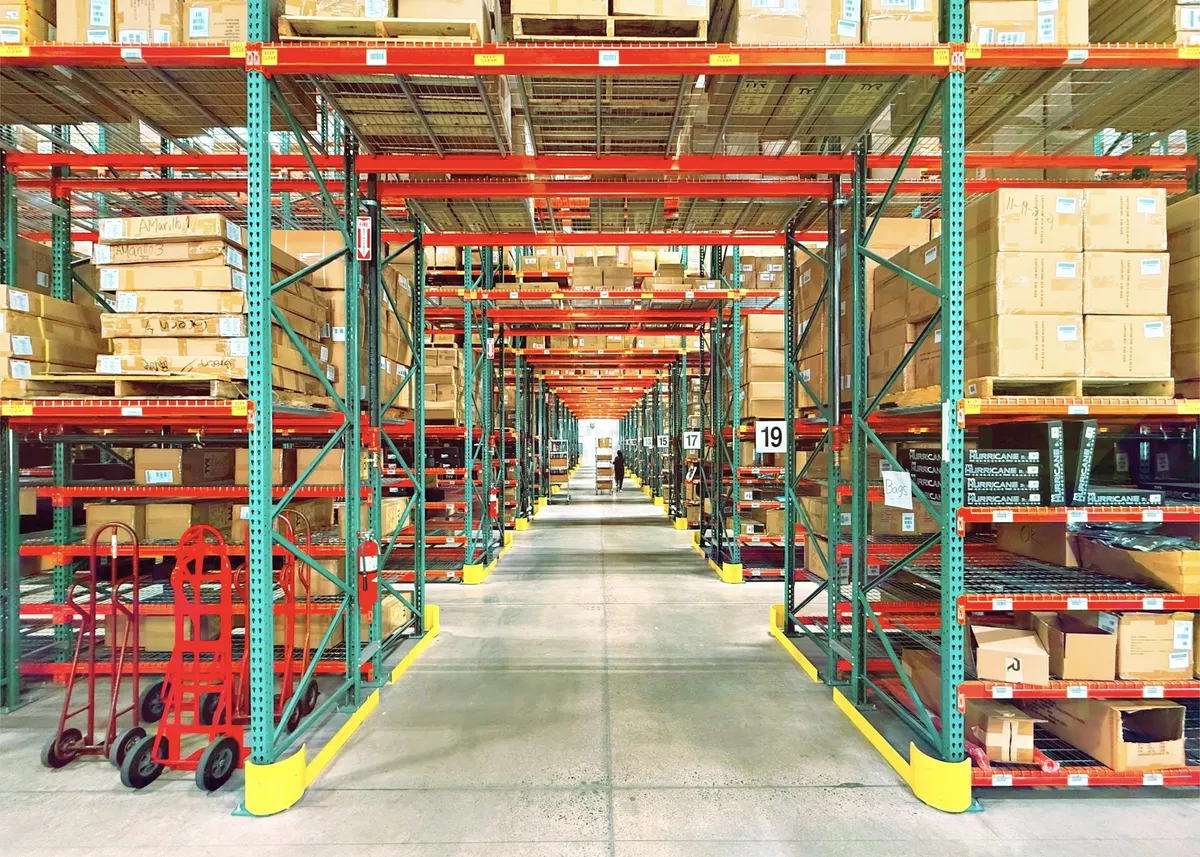
Both systems remove most of the aisles that selective racking needs, and both store pallets several deep in a "lane". The difference is how a pallet gets to and from the back of that lane.
Drive-in and drive-through racking
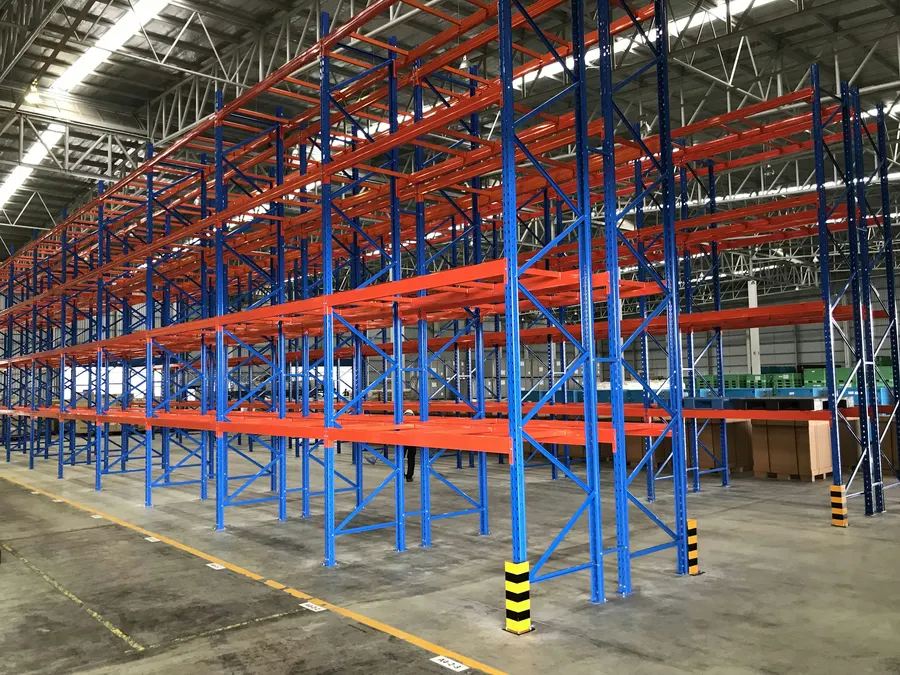
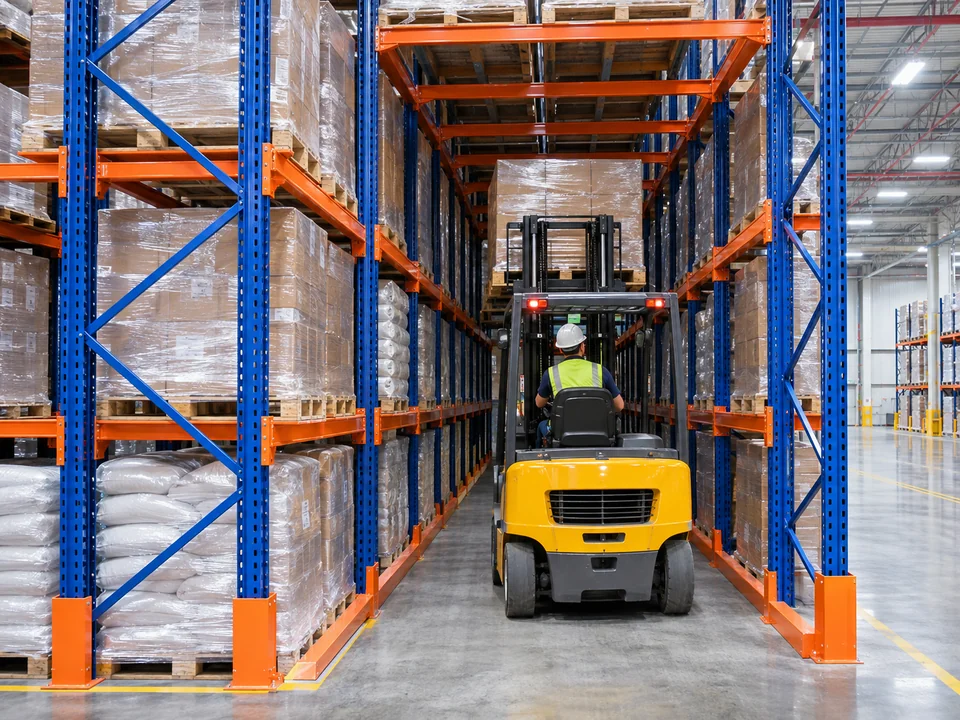
Drive-in racking is a block of uprights with continuous rails running front to back at each level. Pallets rest on those rails by their edges. To load the back of a lane, the forklift drives into the rack structure, sets the pallet down on the rails at the far end, backs out, and repeats, working toward the front. Because the lane is open only at one end, the last pallet in is the first pallet out (LIFO).
Drive-through racking is the same structure open at both ends. Load from one side and unload from the other and you get first-in, first-out (FIFO) rotation — at the cost of an aisle on each side of the block, which gives back some of the density.
Push-back racking
Push-back lanes use inclined rails with nested carts. The forklift sets the first pallet on the top cart. When it loads the next pallet, it pushes the first one back up the slope, and so on until the lane is full. When the front pallet is removed, the pallets behind it roll forward by gravity, so there is always a pallet at the pick face. The forklift never leaves the aisle. Like drive-in, push-back is LIFO.
Side-by-side comparison
| Factor | Drive-in / drive-through | Push-back |
|---|---|---|
| Typical lane depth | Often up to about 10 pallets deep; deeper is possible | Typically 2–6 pallets deep |
| Inventory flow | LIFO (drive-in); FIFO possible with drive-through | LIFO only |
| Forklift enters the rack? | Yes | No |
| Pick faces | One SKU per lane per level; back pallets reachable only after front ones leave | One SKU per lane per level; a pallet is always at the face |
| Honeycombing | Higher (deep lanes empty slowly) | Lower (shorter lanes) |
| Pallet requirements | Consistent size and good condition — pallets rest on rails by their edges | Pallets must suit the cart design; suppliers often test with your pallet |
| Rack damage exposure | Higher — trucks travel between uprights | Lower — trucks work from the aisle |
| Relative cost per position | Lower of the two | Higher (carts and rails) |
| ANSI MH16.1 coverage | Outside the specification's scope — designed per manufacturer and engineer | Pallet rack type designed to MH16.1 |
On that last row: the US rack specification, ANSI MH16.1, states that it is not meant to apply to drive-in or drive-through racks (or cantilever and portable racks), according to the ANSI Webstore listing of the standard (see also our MH16.1 guide). That does not make drive-in less safe; it means you should ask the supplier which design basis and engineering they use. See our ANSI MH16.1-2023 guide.
Density and selectivity: what you actually gain
Density is the reason to buy either system. In Cisco-Eagle's 2025 comparison, a 10-deep drive-in layout scores best for pallet density and worst for selectivity, while 2-deep push-back sits in the middle on both — "a compromise between access ease and density" (Cisco-Eagle). Vendors make bigger claims — one says drive-in can store more than twice what selective rack holds in the same space (AK Equipment, drive-in) and that push-back offers "up to 15%-50% more space" than selective (AK Equipment, push-back) — but the real number depends on your building, aisle widths and lane depths. Run your own layout through the space calculator and ask suppliers for position counts on the same drawing.
The honeycombing trap
Each lane and level should hold a single SKU. When a SKU runs low, the empty positions behind or in front of the remaining pallets cannot be used for anything else. That is honeycombing, and deep lanes make it worse.
Illustration (our arithmetic, not survey data): a SKU arrives as 14 pallets.
- In 10-deep drive-in lanes it needs 2 lanes (10 + 4). The second lane has 6 positions that no other SKU can use.
- In 4-deep push-back lanes it needs 4 lanes (4 + 4 + 4 + 2). Only 2 positions are stranded — and every lane shows a pallet at the face.
The theoretical density advantage of deep lanes only materializes if your SKUs fill them. As a rough rule, the more pallets you hold per SKU, the deeper the lane you can justify.
LIFO, FIFO and inventory rotation
Drive-in and push-back are both LIFO. That suits stable, non-perishable goods that do not need strict rotation — bulk beverages, building products, seasonal stock, many frozen items packed with long shelf lives. It does not suit products where the oldest pallet must ship first.
- Need FIFO with high density? Drive-through racking (load one side, pick the other) or pallet flow racking, which uses gravity rollers to feed the oldest pallet to the pick face.
- Mixed requirements? Many warehouses combine systems: push-back or pallet flow for fast movers, drive-in for deep bulk stock, selective for slow and odd-sized items.
Forklifts, operators and damage risk
Drive-in
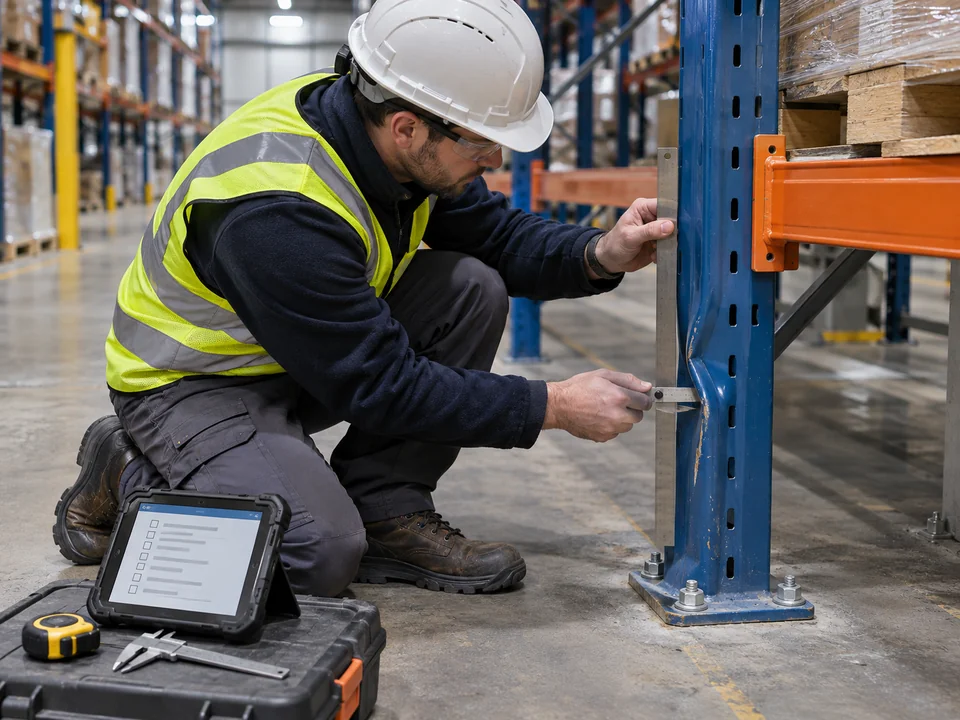
The rack openings must match the width of your forklifts, with enough side clearance to avoid hitting uprights or rails, and operators need to enter, drive and exit slowly (Cisco-Eagle). Pallets that are damaged or the wrong size can slide, fall or crack because they sit on two rails rather than a beam. Floor guide rails and protected entry uprights help. In Cisco-Eagle's older side-by-side scoring, drive-in rated "high" for rack abuse risk against "low" for push-back (Cisco-Eagle, 2014).
Very deep lanes also mean long reverse travel inside the rack. Cisco-Eagle notes that many systems reaching the 10-deep threshold are better done as back-to-back 5-deep systems.
Push-back
Push-back works with standard counterbalance and reach trucks because the truck stays in the aisle. Watch for three things vendors mention: carts can jam if pallets are poor or overloaded, each level typically needs a few inches more height than selective rack, and the maximum lane depth depends on pallet weight and how hard a truck can push (AK Equipment). Ask what cart capacity the quote assumes.
Cost per pallet position
Compare systems per pallet position, not per bay. A drive-in bay holds many more pallets than a selective bay of the same width, so it costs more per bay and less per position. Published ranges are scattered and dated, so treat them as a starting point only:
| System | Published range | Source & notes |
|---|---|---|
| Selective (reference) | $70–100 | AK Equipment (vendor estimate) |
| Selective (reference) | $55–200 single-deep | ECSECO, updated Mar 2024 |
| Drive-in | $150–250 | AK Equipment, includes freight and installation |
| Push-back | $250–500 | AK Equipment (vendor estimate) |
Cisco-Eagle describes drive-in as the least costly high-density option because it has no carts, shuttles or rails that move, while push-back carts add ongoing maintenance. Two cost factors have moved recently: since June 8, 2026, imported steel racks and rack parts carry a 25% Section 232 duty as steel derivatives (Proclamation 11032), and US hot-rolled coil prices in November 2026 were reported around $1,300–1,400 per short ton, up from roughly $830–865 a year earlier (GMK Center). Budget separately for installation, permits and engineering, sprinkler changes, and rack protection.
Decision table
| If your operation looks like this… | Lean toward | Why |
|---|---|---|
| Few SKUs, many pallets of each (deep stock) | Drive-in | Deep lanes fill completely, so density gains are real |
| Many SKUs, roughly 2–6 pallets each | Push-back | Shorter lanes mean less honeycombing |
| Frequent picks from many SKUs, high throughput | Push-back | A pallet is always at the face; no driving into lanes |
| Lowest capital cost per position is the priority | Drive-in | No moving carts or rails |
| Strict FIFO / date rotation required | Pallet flow or drive-through | Both drive-in and push-back are LIFO |
| Inconsistent pallet quality or sizes | Push-back or selective | Drive-in pallets rest on edge rails |
| High operator turnover, damage-prone operation | Push-back | Trucks stay in the aisle |
Questions to ask suppliers
- How many pallet positions does this layout give, and how many will be usable with my SKU profile?
- What lane depth do you recommend, and why?
- What forklift dimensions and clearances does the design assume? (Drive-in.)
- What cart capacity, rail slope and pallet type are assumed — will you test with my pallet? (Push-back.)
- What design standard and engineering apply, and who provides calculations for permits and seismic design?
- What rack protection is included, and what does a damaged rail or cart cost to replace?
- Are freight, installation and permits in the price, and how exposed is the quote to steel price and tariff changes?
Want a second opinion on your layout? Tell us about the project and RackingZone will arrange for suitable pre-screened suppliers to contact you directly.
Frequently asked questions
Per pallet position, drive-in is usually the cheaper high-density option because it has no carts or rails that move. Push-back costs more per position but gives more pick faces and keeps forklifts out of the rack. Published budget ranges vary widely by source, depth and what is included, so compare quotes on a per-position basis for the same layout.
No. Push-back is last-in, first-out: the pallet loaded last sits at the front of the lane. If you need first-in, first-out rotation, look at pallet flow racking or a drive-through layout with aisles on both sides.
Push-back lanes are typically two to six pallets deep. The practical limit depends on the cart design, pallet weight and how hard a forklift has to push. Drive-in lanes can run deeper — many systems are around 10 deep — but deep lanes increase empty "honeycombed" space when a SKU is partly depleted.
Sources
- Cisco-Eagle Evaluation: Pallet Rack Storage Density, Access, Safety and Costs (Apr 2025)
- Cisco-Eagle High Density Pallet Storage: Comparing Pushback, Drive-In and Flow Rail (Dec 2014)
- Cisco-Eagle Tips for Better Drive-In Rack Specifications, Operations and Safety (Dec 2020)
- AK Equipment Drive-In Pallet Racking (vendor page, cost estimate)
- AK Equipment Push-Back Pallet Racks (vendor page, cost estimate)
- ECSECO How Much Does Pallet Racking Cost? (updated Mar 2024)
- Damotech ANSI MH16.1-2023 excerpts (scope and owner duties)
- Federal Register Proclamation 11032 — steel racks added as Section 232 derivatives (FR 2026-11314)
Last reviewed: Nov 2026 by RackingZone Editorial. Spotted an error or an outdated figure? Tell us.