Cantilever Racking
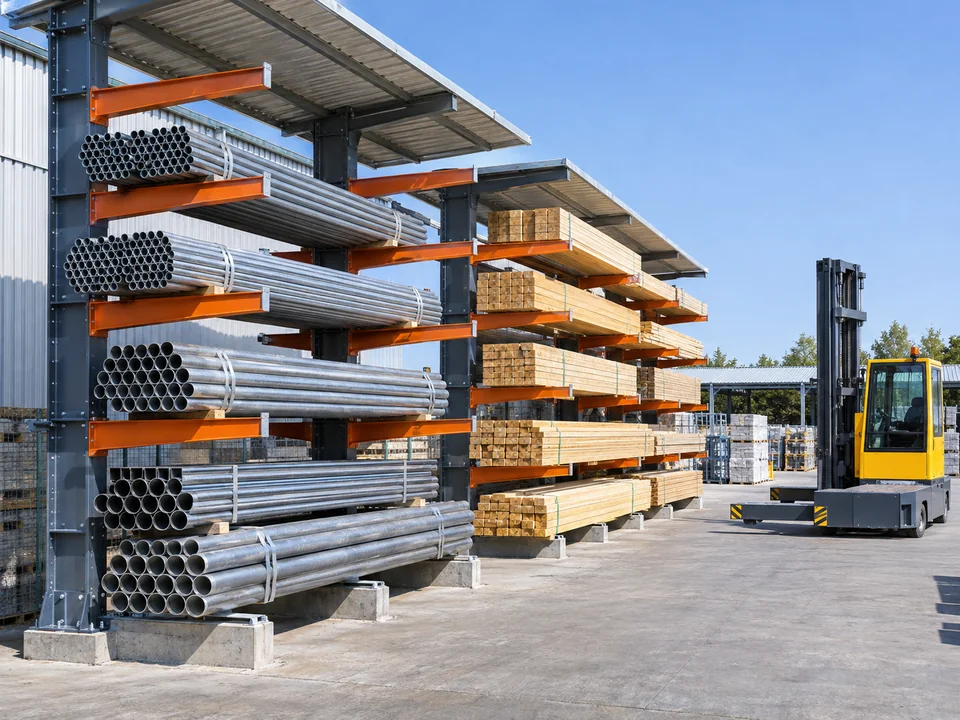
Built for things that don’t fit on a pallet: lumber, pipe, steel bar, tubing, sheet goods and furniture. Arms reach out from a central column with no front upright, so long loads go in and come out from the side with nothing in the way.
Last reviewed: Nov 2026
How Cantilever Racking works
Vertical columns stand on long bases that counter the tipping force of the load, and braces tie the columns together along the run. Arms bolt to the columns at adjustable heights. Single-sided units sit against a wall; double-sided units serve an aisle on each side.
- 01
Columns and bases
The base resists the overturning force of loads on the arms, so base length grows with arm length.
- 02
Arms carry the load
Each arm has a rated capacity. A load has to span enough arms to stay within it — and to keep flexible items from sagging.
- 03
Bracing defines the bays
Horizontal and diagonal braces join the columns. Column spacing follows your load lengths and how stiff the material is.
Strengths and trade-offs
Strengths
- No front columns — long items load from the side
- Arm heights adjust as products change
- Hot-dip galvanized versions suit outdoor yards
- Works with side-loaders, forklifts or overhead cranes
- Can be roofed and clad to create covered storage
Trade-offs
- Inefficient for palletized goods
- Arm capacity and spacing must suit the load’s stiffness
- Large overturning forces — bases and anchoring need careful design
- Wide aisles unless you use side-loaders or multi-directional trucks
What to expect on a spec sheet
| Column height | Roughly 8–20+ ft; taller for clad structures |
|---|---|
| Arm length | Roughly 12–72 in; longer arms available |
| Arm capacity | From a few hundred to several thousand lb per arm |
| Configuration | Single-sided or double-sided |
| Construction | Structural I-beam (heavy duty) or roll-formed (light to medium) |
| Finish | Powder coat indoors; hot-dip galvanized outdoors |
| US design basis | ANSI MH16.3, RMI’s cantilever rack standard (MHI RMI) |
What it costs
We haven’t found reliable published price ranges for cantilever rack, so we don’t quote one. Cost is driven by column height, arm length and capacity, the number of arms, and whether the system is galvanized or clad — suppliers price it per project.
What drives the price
- Arm length and rated capacity
- Single- vs double-sided runs
- Galvanizing for outdoor yards
- Roofing and wall cladding
- Anchoring, wind and seismic design
Published ranges are budget-level orientation from dealers and analysts, not quotes. Prices vary by region, steel market, configuration and scope.
Where it fits best
Lumber & building materials
Dimensional lumber, trusses and panels in yards and stores.
Pipe, tube & bar stock
Steel service centers and fabrication shops.
Sheet goods
Plywood, drywall and metal sheet on deck-equipped arms.
Furniture & rolls
Sofas, carpet and vinyl rolls.
Read before you request quotes
Annual Rack Inspection Checklist
RMI vs. FEM vs. AS 4084: How Rack Standards Differ
Suppliers for Cantilever Racking
Common questions
Long, bulky or irregular items that don’t sit well on pallets — lumber, pipe, bar stock, tubing, sheet goods, furniture and carpet rolls.
Close enough that the load doesn’t sag between arms. Every item should rest on at least two arms, with overhang kept modest; stiffer loads allow wider spacing. Suppliers size it from your shortest, longest and most flexible items.
Yes. Hot-dip galvanized cantilever is common in lumber and steel yards, and some systems add a roof and wall cladding. Outdoor rack must be designed for wind and, where relevant, snow and seismic loads.
Cantilever rack is excluded from ANSI MH16.1; RMI publishes a separate standard for it, ANSI MH16.3. Ask suppliers which edition their design follows.
Images are for reference only. Product and company information comes from partner suppliers; for any purchase, rely on the actual goods confirmed with the supplier.