Accessories & Rack Protection
The small parts that make rack safer and more useful: wire decking, pallet supports, column and end-of-aisle guards, row spacers, safety netting, anchors and load signs. Most are bought with a new system — and they are often the fastest fix after an inspection.
Last reviewed: Nov 2026
How Accessories & Rack Protection works
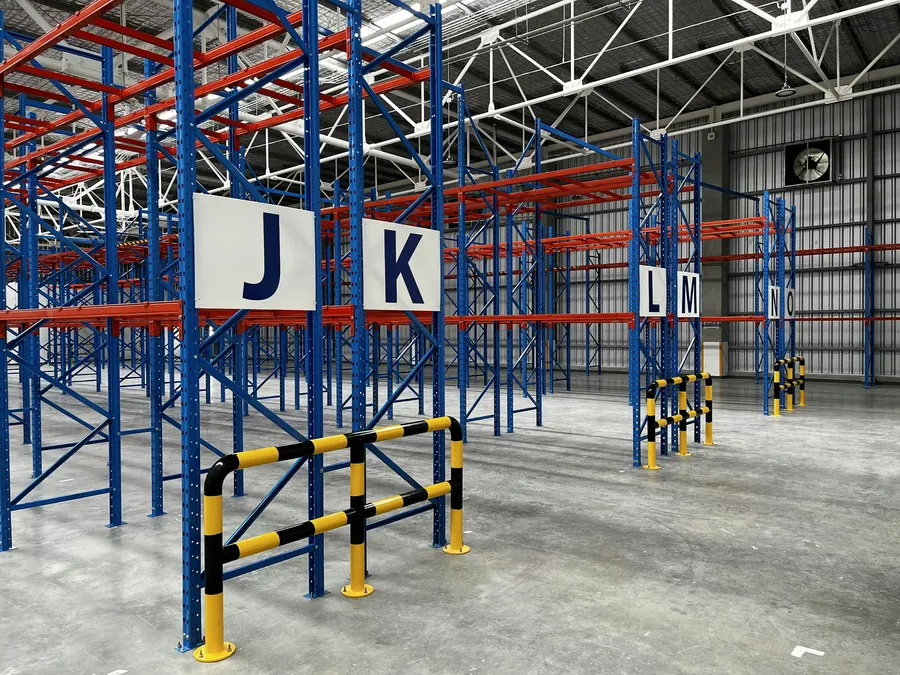
Accessories fall into three groups: load support (wire decks, pallet supports, drum chocks), protection (column guards, end-of-aisle barriers, netting, back stops) and identification (load capacity signs, location labels, aisle signs).
- 01
Support the load
Wire mesh decking catches loads that aren’t perfectly placed and lets sprinkler water through. Pallet supports carry pallets that don’t span both beams.
- 02
Protect the structure
Column guards and end-of-aisle barriers absorb forklift impacts — the leading cause of upright damage.
- 03
Post the rules
ANSI MH16.1 expects the permissible unit load to be shown on the rack. Location labels and aisle signs cut mis-picks too.
Strengths and trade-offs
Strengths
- Cheap compared with replacing a damaged upright
- Wire decking improves safety and sprinkler water penetration
- Guards reduce how often — and how badly — rack gets hit
- Clear load signs support code compliance and inspections
Trade-offs
- Must match the beam profile and rack brand
- Decking must be rated for the actual load and seated correctly
- Some items, such as netting, need engineering for your rack
- Imported welded wire decking now carries a 25% Section 232 duty
What to expect on a spec sheet
| Wire mesh decking | Flared (waterfall) or flush; sized to beam depth and step |
|---|---|
| Deck capacity | Commonly about 1,500–3,000 lb per deck, uniformly distributed |
| Column guards | Bolt-down steel or polymer; roughly 12–24 in tall or more |
| End-of-aisle guards | Floor-anchored steel barriers at row ends |
| Row spacers | Fixed lengths that set the flue space and tie rows together |
| Load signs | Permissible load per level and bay (ANSI MH16.1) |
| Anchors & shims | Per manufacturer and seismic design |
What it costs
Accessories are priced per piece or per bay, so a per-position figure isn’t meaningful. One recent change matters for budgets: welded wire-rack decking and steel rack parts became Section 232 steel derivatives with a 25% duty from June 8, 2026 (Federal Register).
What drives the price
- Beam profile and size
- Rated capacity of the decking
- Steel vs polymer guards
- Quantity per bay and per row end
- Origin and applicable duties
Published ranges are budget-level orientation from dealers and analysts, not quotes. Prices vary by region, steel market, configuration and scope.
Where it fits best
High-traffic aisles
Guards where trucks turn into rows.
Sprinklered buildings
Open wire decks instead of solid boards.
Cartons on rack
Decking for loose cases and odd-size loads.
After an inspection
Replacing missing clips, anchors and signs.
Read before you request quotes
Drive-In vs. Push-Back Racking: Which Fits Your Warehouse?
How to Calculate Pallet Rack Load Capacity
Annual Rack Inspection Checklist
California High-Piled Storage Permits, Explained
ANSI MH16.1-2023: What Rack Buyers Need to Know
From Shuttles to AMRs: Where Warehouse Automation Is Heading
Steel Rack Tariffs: What Buyers Should Know Before Ordering
Suppliers for Accessories & Rack Protection
See all 110 companies listed for Accessories & Rack Protection
Common questions
Not always, but it is widely used. Wire decking supports loads that don’t span both beams, stops items falling through and lets sprinkler water pass. Your fire code official or insurer may have a view on solid versus open decking.
Waterfall (flared) decking wraps over the beam step for a secure fit and is the most common type. Flush decking sits inside the step for a level surface. Either must match the beam’s step size.
ANSI MH16.1 expects the permissible unit load to be posted where it can be seen, and inspectors and insurers routinely check for it. Your rack supplier or engineer should provide the values.
No. They reduce damage from low-speed impacts at the most exposed spots, but aisle width, driver training and lighting matter just as much. Inspect the uprights behind guards too.
Images are for reference only. Product and company information comes from partner suppliers; for any purchase, rely on the actual goods confirmed with the supplier.