Drive-In & Drive-Through Racking
The densest rack a forklift can serve. Instead of an aisle in front of every row, trucks drive into the lanes and set pallets on rails on either side. It suits large quantities of a few SKUs — and operators who accept that only the front pallet of a lane is within reach.
Last reviewed: Nov 2026
How Drive-In & Drive-Through Racking works
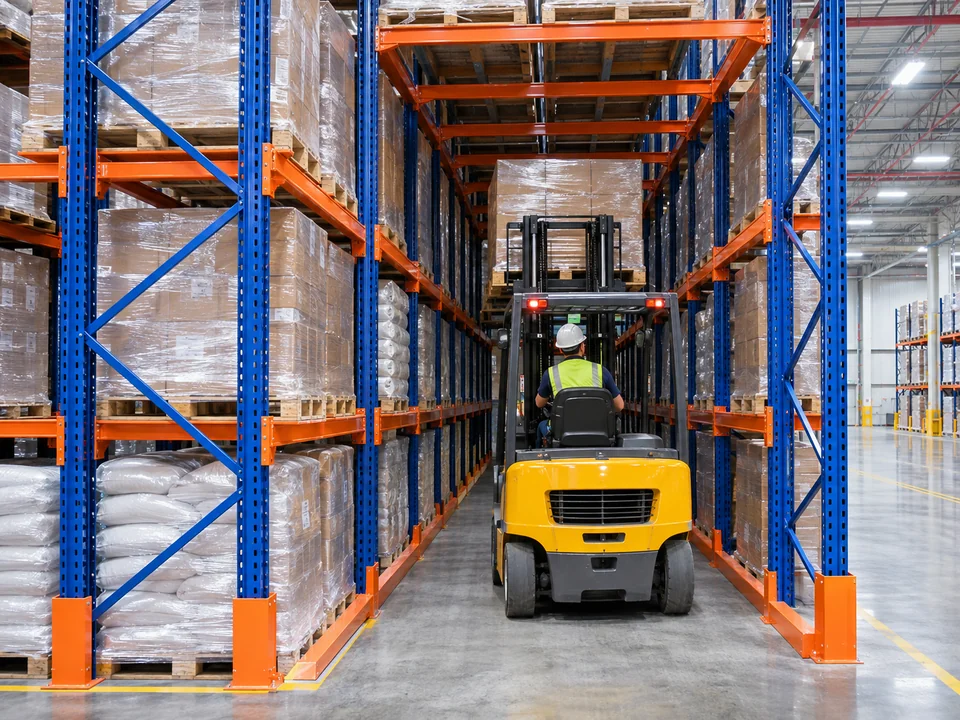
Upright frames form lanes with no beams across the front. Pallets rest on continuous rails fixed to the uprights, and the forklift drives in between them. A drive-in block has one entry, so the last pallet in is the first out. A drive-through block is open at both ends: load from one side, unload from the other.
- 01
One SKU per lane
Each lane — usually each level of a lane — holds a single SKU. Mixing SKUs in a lane means moving pallets out of the way to reach the one you want.
- 02
Rails carry the pallets
Pallets sit on their edges on the rails, so pallet quality and consistent size matter far more than in selective rack. A broken bottom board can drop a load.
- 03
Trucks work inside the structure
Drivers maneuver inside the rack, so floor-level guide rails, good lighting and careful driving are part of the design. Impact damage is the main maintenance issue.
Strengths and trade-offs
Strengths
- Fewest aisles — the most pallets per square foot of any forklift rack
- Uses ordinary counterbalance or reach trucks
- Drive-through layout gives first-in, first-out rotation
- Popular in freezers, where every cubic foot costs money to cool
- Structural versions tolerate heavy use
Trade-offs
- Low selectivity — only the front pallet of each lane is reachable
- Honeycombing: a part-empty lane can’t take another SKU
- Slower cycles while drivers work inside the rack
- More impact damage and stricter pallet requirements
- Outside the scope of ANSI MH16.1 — design rests on the manufacturer and engineer
What to expect on a spec sheet
| Lane depth | Typically 3–10 pallets; deeper lanes are possible |
|---|---|
| Lane width | Pallet width plus clearance for the truck’s mast and overhead guard |
| Storage levels | Commonly 3–5, limited by truck reach and stability |
| Load support | Continuous rails, or rail-and-arm brackets per level |
| Construction | Structural or heavy roll-formed, with top ties and back bracing |
| Floor protection | Entry guide rails recommended at every lane |
| Design basis | Manufacturer + engineer; ANSI MH16.1 excludes drive-in / drive-through (Damotech) |
What it costs
Bastian Solutions budgets two-deep drive-in at about $121–135 per position; other dealer sources cite $75–105 (ECSECO). Used drive-in starts around $55 per position (American Surplus).
- Deeper lanes spread the frame cost over more pallets
- Guide rails, top ties and freezer-grade finishes add cost
- Compare cost per usable position — honeycombing eats into capacity
Published ranges are budget-level orientation from dealers and analysts, not quotes. Prices vary by region, steel market, configuration and scope.
Where it fits best
Cold & frozen storage
Fewer aisles means less air to keep at temperature.
Beverages & bottled water
Heavy, uniform pallets of a handful of SKUs.
Seasonal stock
Build-ups of a few SKUs ahead of a peak.
Bulk raw materials
Bagged or drummed product held in volume.
Read before you request quotes
Drive-In vs. Push-Back Racking: Which Fits Your Warehouse?
Annual Rack Inspection Checklist
Warehouse Space Utilization Calculator
Suppliers for Drive-In / Drive-Through Racking
See all 113 companies listed for Drive-In / Drive-Through Racking
Common questions
Drive-in rack has one entry, so pallets are loaded and retrieved from the same side — last in, first out. Drive-through rack is open at both ends, so you can load from one aisle and retrieve from the other for first-in, first-out rotation, at the cost of a second aisle.
Push-back usually costs more per position, but each lane’s front pallet is available without driving into the rack, and shallower lanes (2–6 deep) mean less honeycombing. Drive-in wins with very deep stock of a few SKUs. Our comparison guide goes through it.
Lanes of 3–10 pallets are common. Deeper is possible, but every extra pallet adds driving time inside the rack and raises the odds of part-empty lanes. Match lane depth to how many pallets of each SKU you actually hold.
No. ANSI MH16.1 excludes drive-in and drive-through rack, so the design relies on the manufacturer’s engineering and your local code official. Ask suppliers which design basis and load tests they use.
Sound, uniform pallets of one size, loaded so the bottom deck boards bridge both rails. Damaged or undersized pallets can slip between the rails. Many operators specify pallet quality together with the rack.
Images are for reference only. Product and company information comes from partner suppliers; for any purchase, rely on the actual goods confirmed with the supplier.