Push-Back Racking
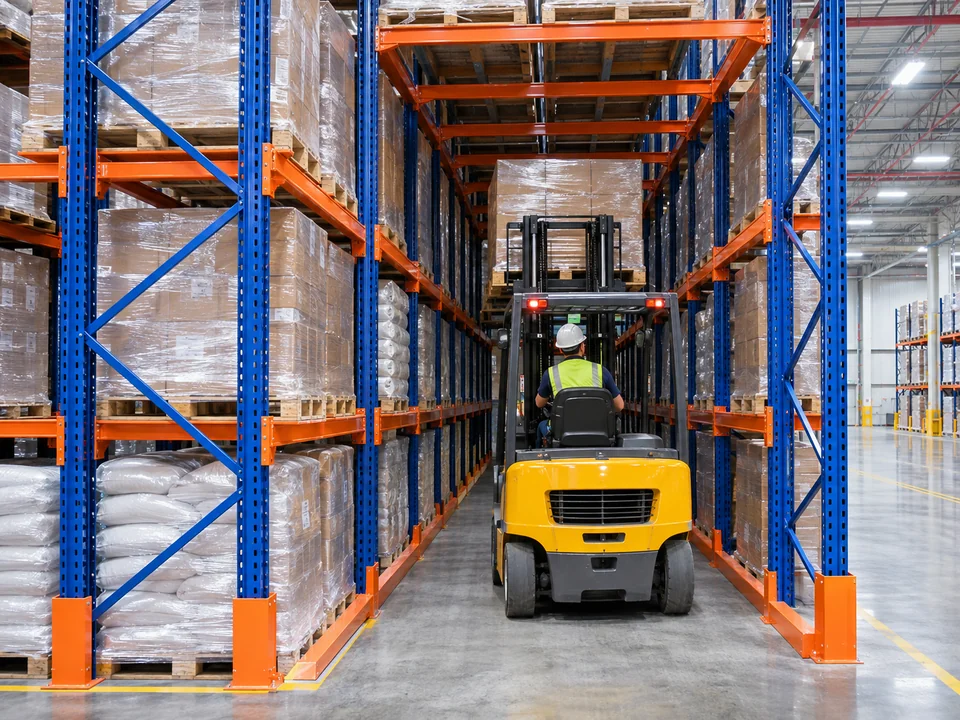
Dense storage that still feels like selective rack from the aisle. Each pallet you load pushes the ones behind it back on nested carts; take the front pallet and the next one rolls forward. Two to six pallets deep, all served from a single aisle face.
Last reviewed: Nov 2026
How Push-Back Racking works
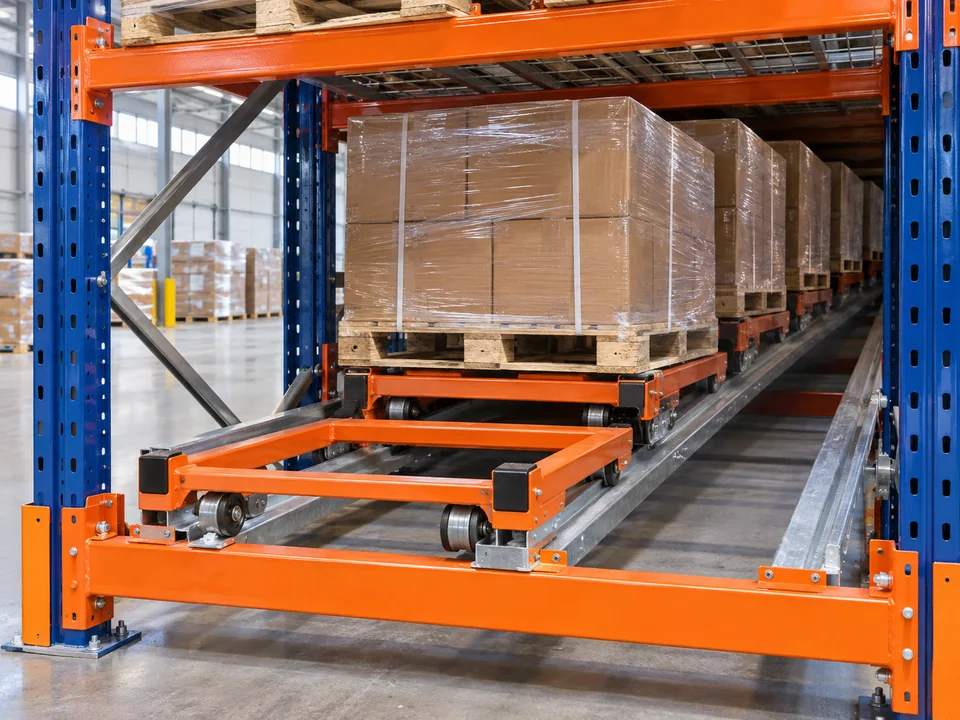
Each lane is a pair of inclined rails carrying a set of nested carts. The forklift sets a pallet on the top cart; the next pallet pushes it back and lands on the cart below. Unloading reverses the process: lift the front pallet and gravity brings the next one to the face.
- 01
Load from the front
The driver places a pallet against the one already in the lane and uses it to push the lane back — the truck never enters the rack.
- 02
Carts or rollers
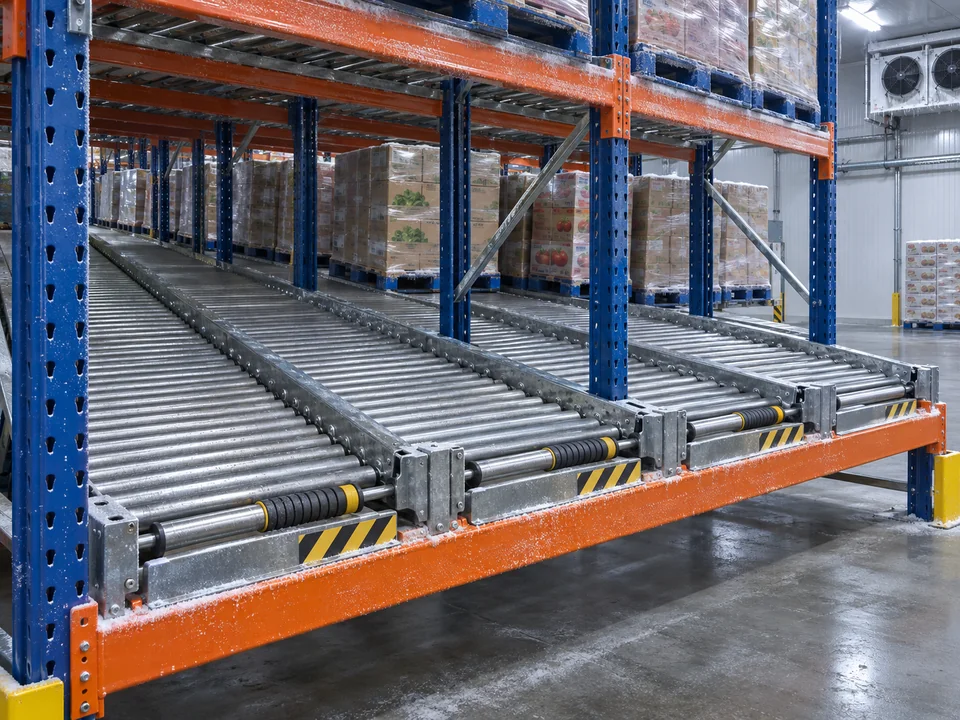
Most systems use nested carts; deeper lanes sometimes switch to roller beds. Either way the rails slope gently toward the aisle.
- 03
The lane feeds itself
Pull the front pallet and the next one rolls forward under control, stopped at the face by the rail stops.
Strengths and trade-offs
Strengths
- Several times more pallets per aisle face than selective rack
- Each lane’s front pallet is always at the face
- Fewer aisles than selective, faster cycles than drive-in
- Works with ordinary counterbalance and reach trucks
- Less honeycombing than drive-in: shorter lanes, one SKU per level
Trade-offs
- LIFO only — not for strict FIFO or date-controlled stock
- Noticeably higher cost per position than selective
- Carts and rails are moving parts that need inspecting
- Pallet weight and condition must stay within the system rating
What to expect on a spec sheet
| Lane depth | 2–6 pallets is typical; deeper lanes use roller beds |
|---|---|
| Cart system | Nested carts on inclined rails, one cart per pallet minus one |
| Pallet weight | Commonly up to about 2,000–3,000 lb; per manufacturer |
| Levels | Several cart levels; the top level is sometimes static |
| Rail slope | Slight incline toward the aisle, set by the manufacturer |
| Structure | Selective-style frames and beams, often structural |
| Design basis | Rack per ANSI MH16.1; carts and rails per manufacturer |
What it costs
Range from Bastian Solutions and MH-USA; two-deep push-back has been budgeted around $151–181 per position. You are paying for cart sets as well as steel.
- Expect a clear premium over selective rack
- Compare cost per pallet stored and per square foot saved, not per position alone
- Installation is more involved — ask who sets up and adjusts the carts
Published ranges are budget-level orientation from dealers and analysts, not quotes. Prices vary by region, steel market, configuration and scope.
Where it fits best
Grocery & food distribution
LIFO-tolerant products with several pallets per SKU.
Finished goods
Manufacturers holding a few days of output per SKU.
Reserve & overflow
Back-up stock behind a selective pick face.
Cold storage
Denser than selective without trucks entering the rack.
Read before you request quotes
Drive-In vs. Push-Back Racking: Which Fits Your Warehouse?
How to Calculate Pallet Rack Load Capacity
ANSI MH16.1-2023: What Rack Buyers Need to Know
Warehouse Space Utilization Calculator
Warehouse Construction Is Picking Up. Here's What It Means for Racking Demand
Suppliers for Push-Back Racking
Common questions
LIFO. Pallets are loaded and unloaded from the same face, so the last pallet in is the first out. For FIFO at similar density, look at pallet flow racking.
Cart-based systems are typically 2–6 pallets deep. Beyond that, manufacturers often switch to roller beds. Deeper lanes add density but also the chance that a lane sits part-empty.
Sometimes. Some push-back systems retrofit into existing frames, but frame capacity, bracing and beam elevations must be checked by the manufacturer or an engineer, because the loading pattern changes.
Include carts, rails and stops in every rack inspection: look for bent rails, damaged carts, missing stops and wheels that bind. Damaged pallets are the most common reason carts hang up.
Images are for reference only. Product and company information comes from partner suppliers; for any purchase, rely on the actual goods confirmed with the supplier.