AS/RS & Shuttle Systems
Automated storage and retrieval systems move loads under software control — stacker cranes in tall aisles, shuttles running in dense lanes, or robots on a grid. They cost more and take longer to plan than conventional rack, but they cut labor, raise density and keep inventory accurate.
Last reviewed: Nov 2026
How AS/RS & Shuttle Systems works
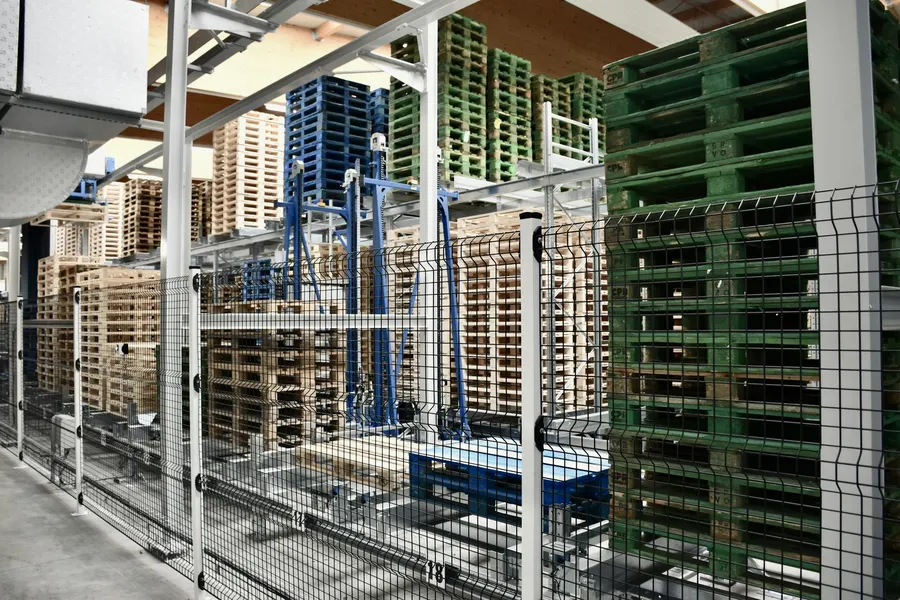
Storage racking — sometimes the building structure itself — is served by machines instead of drivers. Warehouse control software tells the machines where each load belongs and delivers it to an input/output point, a conveyor or a workstation.
- 01
Pick the technology
Unit-load cranes for pallets in tall aisles; pallet shuttles (semi- or fully automated) for deep lanes; mini-load cranes, vertical lift modules and robotic tote systems for cases and small parts.
- 02
Size it for throughput
Systems are designed around moves per hour, peak days and future growth — not storage positions alone.
- 03
Integrate the software
The system talks to your WMS or ERP. Controls, software and service contracts are a large share of the lifetime cost.
Strengths and trade-offs
Strengths
- Highest density — narrow aisles, tall structures, deep lanes
- Fewer forklifts and drivers; consistent round-the-clock operation
- Accurate inventory and full traceability
- Strong case in freezers, where people work less efficiently
- Semi-automated shuttles can be a first step inside existing rack
Trade-offs
- Highest upfront investment and longest lead time
- Less flexible if products or volumes change sharply
- Depends on software, controls and service availability
- Downtime planning and redundancy have to be designed in
- Often needs strict pallet quality and load dimensions
What to expect on a spec sheet
| System types | Unit-load crane, pallet shuttle, mini-load, VLM, robotic tote/cube |
|---|---|
| Height | From standard clear heights to 100 ft+ in rack-supported buildings |
| Load types | Pallets, totes, cartons or trays — system-specific |
| Throughput | Designed per project, in moves (cycles) per hour |
| Temperature | Ambient to deep-freeze, with rated components |
| Integration | WMS / ERP interface and warehouse control software |
| Design basis | Rack to the applicable standard (e.g., ANSI MH16.1; FEM / EN 15512 for some imported systems) plus machinery safety rules |
What it costs
AS/RS is priced as a project: storage structure, machines, conveyors, controls, software, installation and service. Budgets hinge on throughput, height and integration scope, so a per-position figure would mislead. For scale, analysts size the North American AS/RS market at roughly $3.0–3.1 billion in 2025 (MarketsandMarkets, Global Market Insights).
What drives the price
- Required throughput (moves per hour)
- Building height; new or existing building
- Temperature zone
- Software and integration scope
- Service contract and spare parts
Published ranges are budget-level orientation from dealers and analysts, not quotes. Prices vary by region, steel market, configuration and scope.
Where it fits best
Frozen food
Fewer people working at −10 °F and below.
E-commerce fulfillment
Goods-to-person picking for many small orders.
Pharma & healthcare
Traceability, lot control and secure storage.
Manufacturing buffers
Automated feeding of production lines.
Read before you request quotes
RMI vs. FEM vs. AS 4084: How Rack Standards Differ
Warehouse Space Utilization Calculator
From Shuttles to AMRs: Where Warehouse Automation Is Heading
Suppliers for AS/RS & Shuttle Systems
Common questions
A unit-load AS/RS uses a crane that travels each aisle and reaches every level. A pallet shuttle runs inside deep storage lanes; in semi-automated systems a forklift moves the shuttle between lanes, while fully automated systems add lifts or transfer cars.
Common triggers are high and steady throughput, labor shortages or cost, freezer operations, expensive land that pushes you to build tall, and a need for accurate inventory. Low or unpredictable volumes usually favor conventional rack.
Sometimes. Shuttles and vertical lift modules often fit existing buildings; tall unit-load cranes usually need clear height and floor flatness that older buildings lack. A site survey settles it.
It varies widely with scope, through design, simulation, manufacturing, installation and commissioning. Ask suppliers for a realistic timeline and what they need from you to hold it.
Images are for reference only. Product and company information comes from partner suppliers; for any purchase, rely on the actual goods confirmed with the supplier.