RMI vs. FEM vs. AS 4084: How Rack Standards Differ
Racks designed in one market are often bought in another. Here is how the US, European and Australian rack standards line up — and what to check before you import.
This guide is general information, not engineering or legal advice. Requirements vary by jurisdiction and by manufacturer — confirm with a qualified engineer, your rack supplier and your local authority.
Key takeaways
- The US uses ANSI MH16.1 from the Rack Manufacturers Institute (RMI). Europe uses the EN standards developed in CEN — EN 15512 for design, EN 15635 for use and maintenance, EN 16681 for seismic — with FEM codes behind them. Australia uses AS 4084.1 (design) and AS 4084.2 (operation and maintenance).
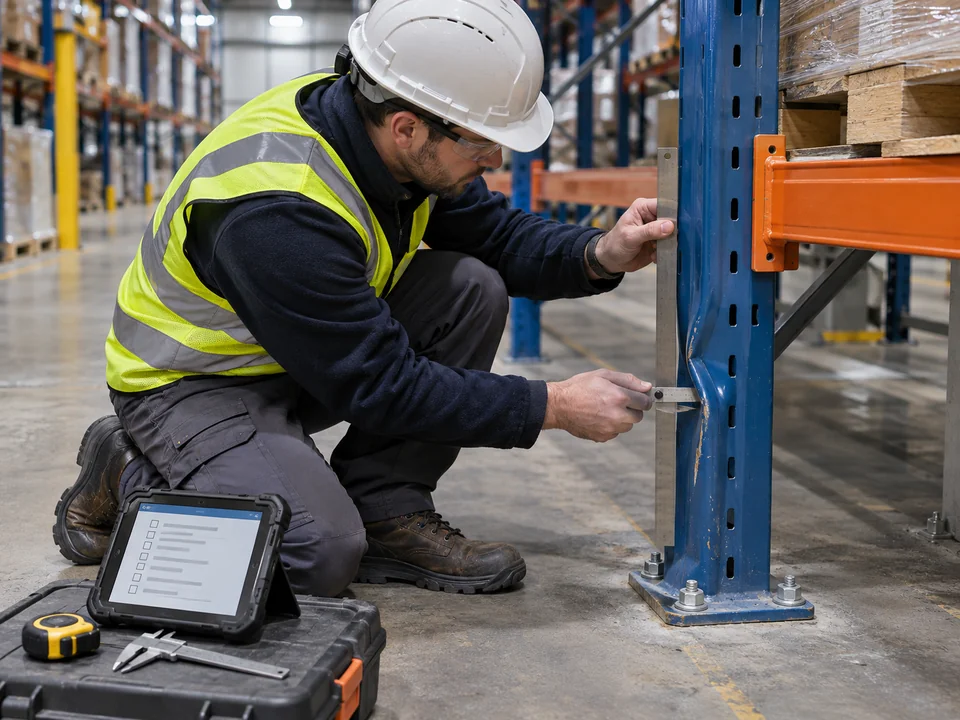
- All three put inspection on the user, but the wording differs: RMI recommends at least annual inspections by a qualified person; UK guidance (HSG76) asks for expert inspections at intervals of not more than 12 months; Australian regulators say formal inspections by a competent person at intervals not exceeding 12 months.
- A rack designed to EN or AS standards is not automatically acceptable in the US. Your permit will be reviewed against the US building code, ASCE 7 seismic rules and ANSI MH16.1, usually with calculations stamped by an engineer licensed in your state.
- When importing, ask for US-code calculations, LARC drawings and load plaques in US units before you sign — not after the racks arrive.
At a glance
| United States | Europe / UK | Australia | |
|---|---|---|---|
| Issuing body | RMI (part of MHI), ANSI-accredited | CEN (European standards); FEM Racking & Shelving group converts its codes into EN standards | Standards Australia |
| Design standard | ANSI MH16.1-2023 (pallet racks, incl. push-back and pallet flow); MH16.3 (cantilever) | EN 15512:2020+A1:2022 (adjustable beam pallet racking; excludes push-back, pallet live and drive-in) | AS 4084.1:2023 |
| Use & maintenance | Owner duties in MH16.1 Section 4; RMI guidance | EN 15635:2008 (under review per BSI); in the UK, HSE guidance HSG76 | AS 4084.2:2023 (Amd 1:2024) |
| Seismic | MH16.1 seismic provisions aligned with ASCE/SEI 7-22; building codes refer to ASCE 7 Section 15.5.3 | EN 16681:2016, used with EN 1998-1 (Eurocode 8) and EN 15512 | Earthquake actions under the Australian loading standards — confirm the approach with the designer |
| Expert inspection | At least annually by a qualified person (RMI recommendation) | UK: technically competent person, intervals of not more than 12 months (HSG76) | Competent person, intervals not exceeding 12 months (SafeWork NSW, WorkSafe Victoria) |
| Routine checks | Owner's program; post-installation inspection by the owner (MH16.1-2021 onward) | UK: weekly or other regular visual inspections organized by the person responsible for racking safety (PRRS) | Frequent informal inspections, based on manufacturer or competent-person advice |
| Industry marks & schemes | RMI R-Mark (load-table calculations independently reviewed) | UK: SEMA Approved Racking Inspectors (SARI); SEIRS installer cards | No equivalent national mark identified in our review |
United States: RMI and ANSI MH16.1
ANSI MH16.1 covers the design, testing and use of industrial steel pallet racks and related systems, and excludes drive-in and drive-through, cantilever and portable racks; cantilever racks have ANSI MH16.3. The 2023 edition aligned the seismic provisions with ASCE/SEI 7-22 (RMI FAQ). RMI says the International Building Code requires racks to be designed to the applicable ANSI/RMI standard, and California plan reviewers ask for ASCE 7 Section 15.5.3 seismic design and stamped calculations (City of Fresno).
On inspection, RMI recommends a program of regularly scheduled inspections by "a qualified person familiar with the storage rack design and installation requirements," at least annually, and immediately after events such as earthquakes (RMI FAQ). OSHA has no rack-specific rule; it relies on the General Duty Clause. More detail: ANSI MH16.1-2023 explained.
Europe and the UK: EN 15512, EN 15635 and FEM
In Europe, rack design is covered by European Standards developed in CEN technical committee TC 344. The FEM Racking & Shelving product group — part of the European materials handling federation — participates in that committee and is converting its own FEM codes into EN standards; it has also published codes for shelving, drive-in and cantilever racking (FEM). That is why European spec sheets often say "designed to FEM" or "to EN 15512." Ask which document and edition.
- EN 15512:2020+A1:2022 — structural design of steel adjustable beam pallet racking. BSI's listing excludes mobile storage, drive-in and drive-through, pallet live (flow) storage, push-back, shuttle systems, cantilever racks and static shelving (BSI). Note the contrast with MH16.1, whose scope includes push-back and pallet-flow racks.
- EN 15635:2008 — application and maintenance of storage equipment, including safety and inspection in use and rules for measuring and classifying damage to uprights and bracing. BSI lists it as current and under review (BSI).
- EN 16681:2016 — principles for seismic design of adjustable pallet racking, used with EN 1998-1 and EN 15512 (BSI).
UK inspection practice and SEMA
The UK Health and Safety Executive's guide HSG76, Warehousing and storage (2nd edition) describes a layered approach:
- Immediate reporting of any damage to a nominated person responsible for racking safety (PRRS);
- visual inspections at weekly or other regular intervals based on risk assessment, with a written record;
- expert inspections by a technically competent person at intervals of not more than 12 months, with a written report — for example a trained in-house specialist, a specialist from the rack supplier, or an independent qualified rack inspector.
HSG76 uses a traffic-light damage scale: red means very serious damage — offload and isolate immediately — and amber damage should be redesignated red if it is not repaired within four weeks. The Storage Equipment Manufacturers' Association (SEMA) trains and lists SEMA Approved Racking Inspectors (SARI) and runs the SEIRS installer registration scheme (SEMA). SEMA notes its guidance is not itself a legal requirement, though HSE can refer to HSG76 and SEMA codes when taking enforcement action (SEMA). Practice in other European countries follows national rules.
Australia: AS 4084
Australia's steel storage racking standard was split in 2023. AS 4084.1:2023 covers design and replaced AS 4084-2012; AS 4084.2:2023 covers operation and maintenance and has an amendment (Amd 1:2024) (Standards Australia, Part 1; Part 2).
State regulators turn this into practical guidance. SafeWork NSW says formal inspections "shall be conducted by a competent person, at intervals not exceeding 12 months," and points to AS 4084 for inspection guidance (SafeWork NSW). WorkSafe Victoria describes frequent informal inspections plus a formal inspection by a competent person every 12 months, and three damage levels: very serious (immediate action), hazardous (repair as soon as possible, within four weeks, or it becomes very serious) and acceptable (monitor until the next inspection) (WorkSafe Victoria).
Why it matters when you import racking into the US
Racking is traded internationally, and European and Australian manufacturers design to demanding standards of their own. The issue is not quality — it is that US permits and inspections are judged against US documents:
- The design has to meet the adopted US code. Building departments review racks against their building code, ASCE 7 seismic provisions and ANSI MH16.1. A calculation package to EN 15512 or AS 4084.1 alone will usually not be accepted.
- Seismic inputs are different. EN 16681 works with Eurocode 8; US design uses ASCE 7 ground-motion data and seismic design categories. In high-seismic areas such as much of California, anchorage and frame design can change significantly.
- A local engineer's stamp is common. LA County and Fresno, for example, require structural calculations by a California-licensed engineer for racks 8 ft and taller (LA County DPW).
- Documentation must work for the owner. MH16.1 expects load plaques and LARC drawings. Plaques in kilograms and component data that only exists in another language make future inspections, repairs and reconfiguration harder.
- Mixing parts is risky. RMI warns that testing is needed to validate the capacity of mixed components (MMH). Imported beams on domestic uprights — or the reverse — need engineering.
Marks and certificates from one market do not transfer automatically to another. Treat FEM, EN, AS, SEMA or CE claims as evidence of the supplier's design practice, and still ask for US-code calculations for your site.
Buyer checklist for imported or foreign-standard racking
- Which standard and edition were the components designed and tested to?
- Will the supplier provide site-specific calculations to ANSI MH16.1 and ASCE 7, stamped by an engineer licensed in your state?
- Are the seismic inputs for your site (ASCE 7 data, site class, design category) shown in the calculations?
- Will you receive LARC drawings and load plaques in pounds and inches for every configuration?
- Are anchors specified with a US evaluation report, and is special inspection planned where required?
- Can the supplier support permit review comments, replacement parts and future reconfiguration from the US?
- Is there an R-Mark certificate, or another independent review of the capacity calculations?
- Who installs, and who carries out the first inspection after installation?
Use the directory filters to find suppliers that list RMI R-Mark, ANSI MH16.1 design, FEM or SEMA, or tell us about your project — RackingZone will arrange for suitable pre-screened suppliers to contact you directly.
Frequently asked questions
RMI writes ANSI MH16.1, the US rack design specification, which is tied to US building codes and ASCE 7 seismic design. In Europe, rack design is covered by EN standards such as EN 15512 (design), EN 15635 (use and maintenance) and EN 16681 (seismic); the FEM Racking & Shelving group participates in that work and converts its FEM codes into EN standards. The documents, scopes and seismic methods differ.
AS 4084 is the Australian steel storage racking standard. Since 2023 it has two parts: AS 4084.1:2023 for design and AS 4084.2:2023 for operation and maintenance (amended in 2024). State regulators such as SafeWork NSW and WorkSafe Victoria refer to it in their racking guidance.
UK guidance (HSE HSG76) asks for weekly or other regular visual inspections and expert inspections by a technically competent person at intervals of not more than 12 months. Australian regulators say formal inspections by a competent person at intervals not exceeding 12 months. In the US, RMI recommends inspections by a qualified person at least annually.
SEMA, the UK Storage Equipment Manufacturers' Association, trains and lists SEMA Approved Racking Inspectors (SARI) to carry out expert inspections. HSE guidance names an independent qualified rack inspector as one option for the technically competent person. SEMA approval is a UK industry scheme, not a US requirement.
Only if the design is shown to meet the US building code your jurisdiction adopted — typically ANSI MH16.1 and ASCE 7 seismic provisions — and the building department approves it. Many California jurisdictions require calculations stamped by a California-licensed engineer for racks 8 ft and taller. Ask the supplier for US-code calculations before you buy.
Sources
- RMI (MHI) Rack Manufacturers Institute FAQ — MH16.1 editions, inspection, R-Mark
- FEM Racking & Shelving product group (CEN TC 344, conversion of FEM codes into EN standards)
- BSI BS EN 15512 — Adjustable pallet racking systems: principles for structural design
- BSI BS EN 15635:2008 — Application and maintenance of storage equipment
- BSI BS EN 16681:2016 — Adjustable pallet racking systems: principles for seismic design
- HSE HSG76 Warehousing and storage: a guide to health and safety (2nd ed.)
- SEMA Find a SEMA Approved Racking Inspector (SARI)
- SEMA Racking regulations (status of HSG76 and SEMA codes)
- Standards Australia AS 4084.1:2023 Steel storage racking — Design
- Standards Australia AS 4084.2:2023 Steel storage racking — Operation and maintenance
- SafeWork NSW Pallet racking guide
- WorkSafe Victoria Pallet racking operation and maintenance (reviewed Apr 2024)
- County of Los Angeles DPW Steel Storage Racks Plan Review List (Jan 2026)
- City of Fresno Storage Racks Plan Submittal Guidelines (Apr 2026)
- Modern Materials Handling Don't Underestimate Rack Maintenance & Repair (RMI on mixed components, Sep 2018)
Last reviewed: Nov 2026 by RackingZone Editorial. Spotted an error or an outdated figure? Tell us.