Selective Pallet Racking
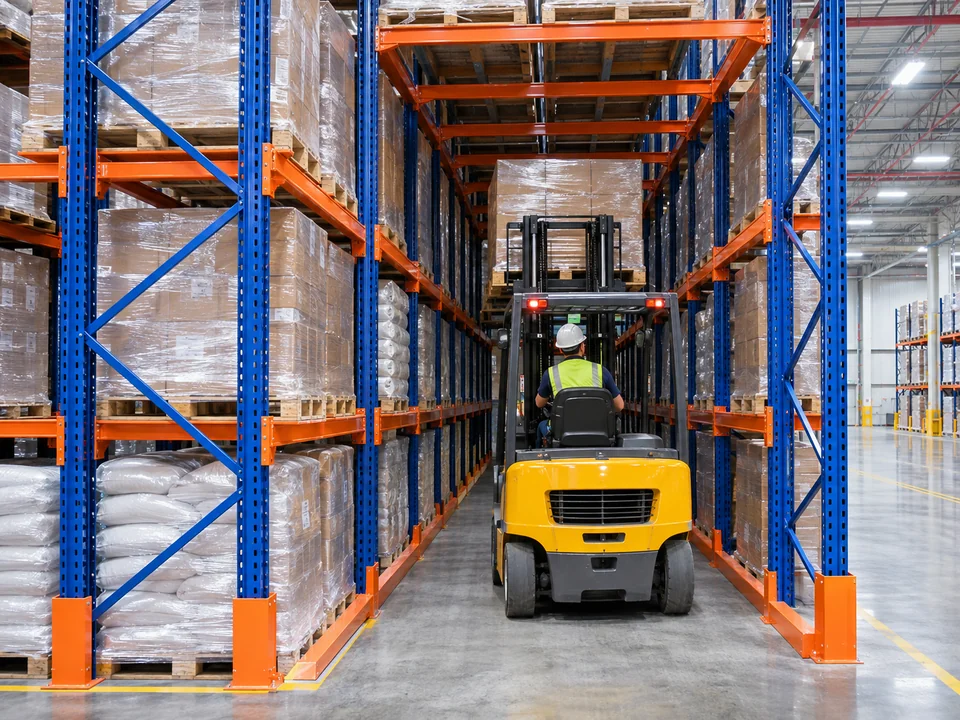
The workhorse of North American warehouses: one pallet deep on each side of an aisle, so every load can be reached without moving another. If you carry many SKUs and handle full pallets, this is the baseline every other system gets compared against.
Last reviewed: Nov 2026
How Selective Pallet Racking works
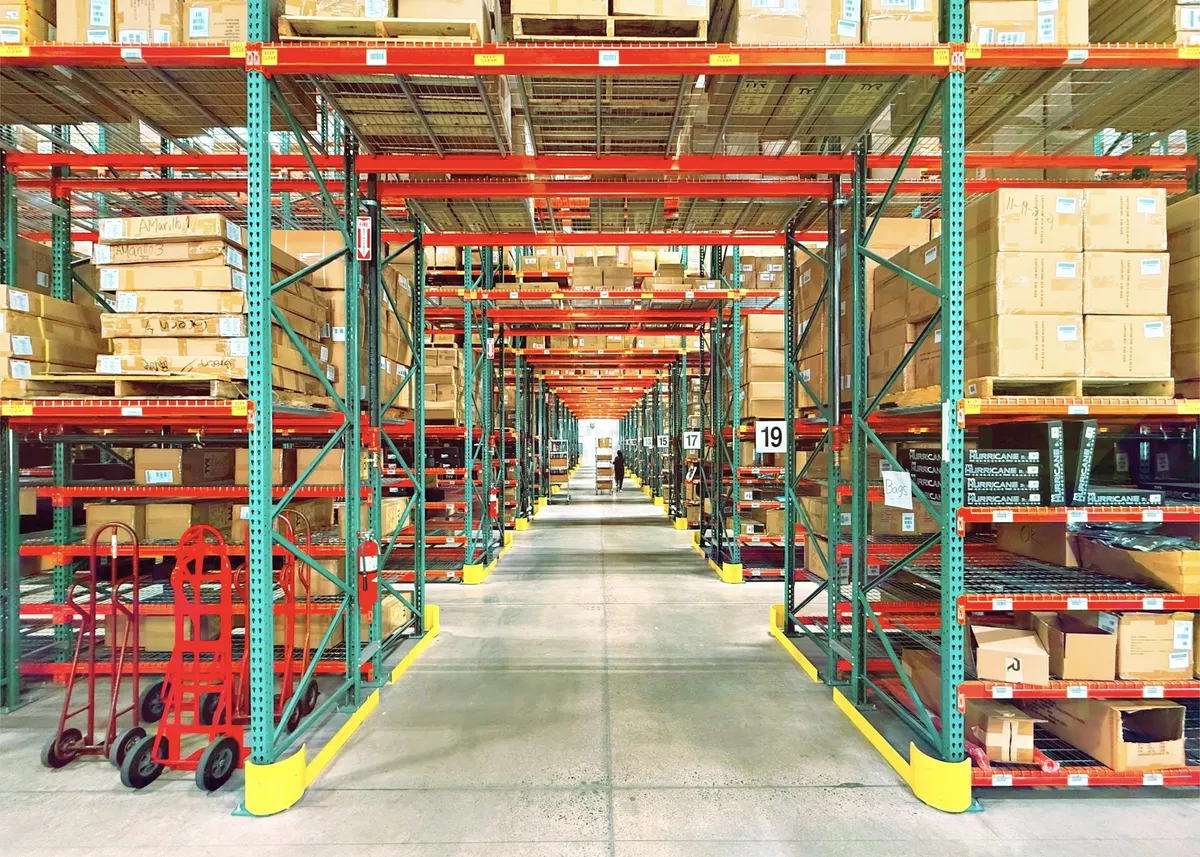
Upright frames — two columns braced together — stand in rows, and pairs of horizontal beams connect the frames to carry the pallets. Rows usually run back-to-back, tied with row spacers, with an aisle wide enough for your lift truck in between.
- 01
Frames and beams
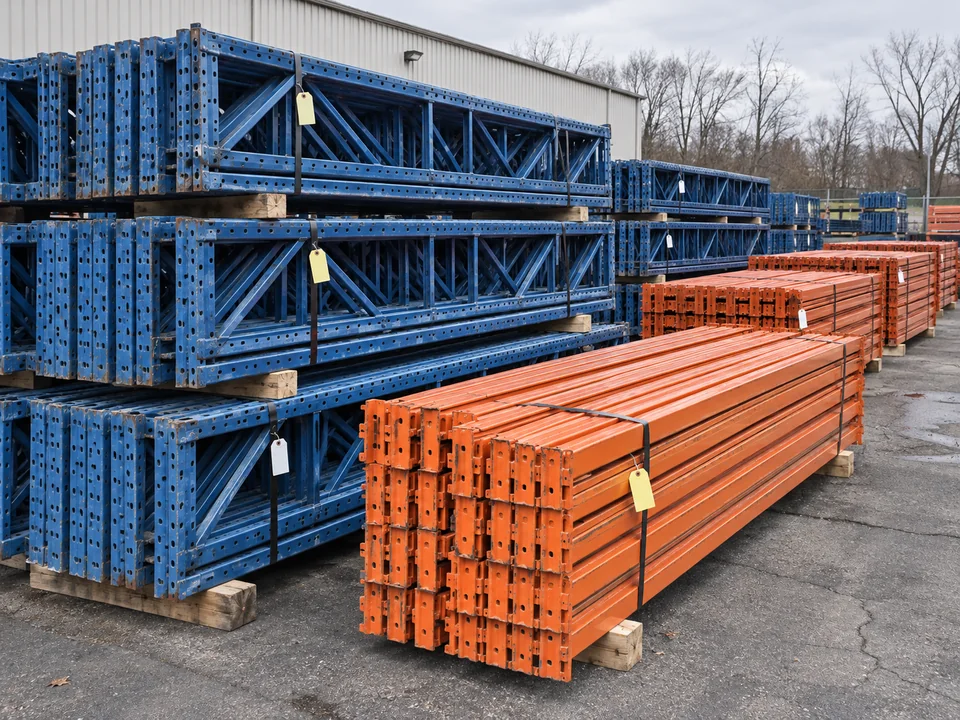
Roll-formed systems use teardrop-shaped slots so beams drop in and lock with a safety clip, which makes them quick to adjust. Structural systems bolt hot-rolled channel beams to the columns and stand up better to abuse.
- 02
Load per beam level
Each beam pair is rated for a uniformly distributed load, typically two pallets side by side. Frame capacity depends on the vertical gap between beam levels, so moving beams changes the rating.
- 03
Aisles set the density
Counterbalance trucks typically need 11–13 ft aisles, reach trucks around 8–10 ft and guided VNA trucks less. Narrower aisles fit more rows into the same building — with different trucks.
Strengths and trade-offs
Strengths
- Direct access to every pallet — ideal for many SKUs
- Lowest cost per pallet position of the pallet systems
- Works with almost any forklift and pallet size
- Easy to reconfigure, extend or relocate
- Widest supplier base and an active used market
Trade-offs
- Lowest storage density — a large share of the floor ends up as aisle
- Every row face needs its own aisle
- Teardrop parts from different makers don’t always mix safely
- Taller systems may need engineering, permits and seismic anchoring
What to expect on a spec sheet
| Upright frame height | 8–40+ ft; 12–24 ft is common in distribution |
|---|---|
| Frame depth | 36–48 in; 42 in is typical for 48 × 40 in pallets |
| Beam length | 4–12 ft; 96 in and 108 in two-pallet bays are common |
| Beam capacity (per pair) | Roughly 2,000–6,000+ lb, by profile and length |
| Frame capacity | Often 10,000–30,000+ lb, falling as beam spacing grows |
| Construction | Roll-formed (teardrop or other slot pattern) or structural channel |
| Finish | Powder coat standard; galvanized for wet or outdoor areas |
| US design basis | ANSI MH16.1-2023 (RMI); seismic per ASCE 7 / IBC |
What it costs
Budget figure from Bastian Solutions. Another dealer, MH-USA, puts complete new systems at $80–300 per position — most of the gap is what the number includes.
- Freight, installation, permits and engineering are extra
- Steel prices and the 25% Section 232 duty on steel racks (since June 2026) push recent quotes up
- Planning math (estimate): 5,000 positions × $50–75 ≈ $250,000–375,000 in rack material alone
Published ranges are budget-level orientation from dealers and analysts, not quotes. Prices vary by region, steel market, configuration and scope.
Where it fits best
3PL & contract warehousing
Customers and SKUs change constantly; access to every pallet keeps the layout flexible.
Retail & e-commerce DCs
Broad assortments received as pallets and picked as cases.
Manufacturing
Raw material and work-in-process staged by part number.
Wholesale distribution
Building products, auto parts, MRO and industrial supplies.
Read before you request quotes
How to Calculate Pallet Rack Load Capacity
Annual Rack Inspection Checklist
California High-Piled Storage Permits, Explained
ANSI MH16.1-2023: What Rack Buyers Need to Know
RMI vs. FEM vs. AS 4084: How Rack Standards Differ
Pallet Racking Load Calculator
From Shuttles to AMRs: Where Warehouse Automation Is Heading
Warehouse Construction Is Picking Up. Here's What It Means for Racking Demand
Steel Rack Tariffs: What Buyers Should Know Before Ordering
Suppliers for Selective Pallet Racking
Common questions
Teardrop (roll-formed) rack has teardrop-shaped holes, so beams hook in and lock with a safety clip — quick to install and adjust. Structural rack uses hot-rolled channel columns with bolted beams; it is heavier, costs more and takes forklift impacts better, which is why it is common in freezers and busy dock areas.
It depends on the beam profile, its length and the manufacturer. Common two-pallet beams are rated somewhere around 2,000–6,000 lb per pair, uniformly distributed. Use the manufacturer’s load chart for the exact part and post the rated capacity on the rack. Our load capacity guide walks through the math.
Often, yes. Many jurisdictions require a building permit and engineering calculations above a certain rack height (some California cities draw the line at 8 ft), and storage over 12 ft can count as high-piled storage under the fire code. Check with your local building and fire departments — see California high-piled storage permits.
Avoid it unless the manufacturer or an engineer approves. Slot patterns that look alike can differ in shape and tolerance, and published capacities assume matching components. Mixed systems are a common finding in rack inspections.
It depends on the truck. As a rule of thumb, counterbalance forklifts need about 11–13 ft, reach trucks about 8–10 ft, and wire- or rail-guided VNA trucks less. Start from your truck’s right-angle stacking dimension plus clearance, and confirm with your supplier and fire marshal.
Images are for reference only. Product and company information comes from partner suppliers; for any purchase, rely on the actual goods confirmed with the supplier.