Annual Rack Inspection Checklist
Who inspects, how often, what to look for — and a printable checklist you can take onto the floor. Plus the steps to follow the moment someone finds a damaged upright.
This guide is general information, not engineering or legal advice. Requirements vary by jurisdiction and by manufacturer — confirm with a qualified engineer, your rack supplier and your local authority.
Key takeaways
- RMI recommends regularly scheduled rack inspections by a qualified person, at least annually — more often in busy or damage-prone areas, and immediately after an impact or earthquake.
- OSHA has no rack-specific rule or inspection interval, but can cite rack hazards under the General Duty Clause; ANSI MH16.1 and manufacturer instructions define what "safe" looks like.
- Layer your program: daily operator checks, monthly internal inspections, and an annual expert inspection.
- When damage is found: unload and isolate the bay first, then assess, then repair or replace with engineered parts.
What the standards and regulators say
OSHA
OSHA does not have a standard written specifically for storage racks, and it does not publish a rack inspection interval. Rack hazards are typically cited under the General Duty Clause — Section 5(a)(1) of the OSH Act, which requires employers to keep the workplace free of recognized hazards — with manufacturer instructions or ANSI MH16.1 used to show the hazard was recognized; unanchored racks are a frequent example (J. J. Keller). OSHA's general materials-handling rule also applies: "Storage of material shall not create a hazard," and stored tiers must be stable and secure against sliding or collapse (29 CFR 1910.176(b)). State OSHA plans, such as Cal/OSHA, can add their own requirements.
ANSI MH16.1-2023
The US rack specification, written by the Rack Manufacturers Institute (RMI), puts the owner in charge of the rack's structural integrity once it is installed. According to Damotech's summary of the 2023 edition:
- owners are expected to protect the rack's integrity, including inspecting for damage (Section 4.1);
- when damage is found, the affected portion is to be isolated, and it only goes back into service after a registered design professional certifies it has been restored (Section 4.4);
- columns out of plumb or out of straight by more than 1/240 of their height are to be unloaded and corrected (Section 4.10) — about 1/2 in over 10 ft;
- columns are anchored to the floor, with a limited exception for some hand-loaded racks 8 ft or lower (Section 4.2);
- load plaques are posted and kept current (Section 4.5).
The standard does not cover inspection, assessment and repair work in detail; RMI publishes separate guidance on assessing and repairing damaged rack.
RMI guidance on frequency
As reported by Modern Materials Handling, RMI says owners should run regularly scheduled storage rack inspections, performed by "a qualified person familiar with storage rack design and installation requirements," and that "as a minimum, inspections should be performed at least annually." A lift truck collision or seismic event calls for an immediate review. RMI lists factors that justify more frequent inspection — product value, aisle clearances, transfer aisles and previous damage, alongside higher product velocity and traffic — and recommends that the schedule and results be documented and kept.
Outside the US, Europe and Australia have their own inspection regimes; see how rack standards differ.
Who inspects, and how often
Most well-run sites use three layers. The intervals below are common practice (Damotech describes the same pattern: daily-to-weekly visual checks, monthly internal inspections, and at least an annual expert inspection) — set your own based on traffic and damage history.
| Layer | Typical frequency | Who | Output |
|---|---|---|---|
| Operator check | Daily or each shift | Forklift operators and pickers, trained to spot and report damage | Immediate report of impacts and visible damage |
| Internal inspection | Monthly (more often in high-traffic zones) | Trained supervisor or safety lead using a checklist like the one below | Written record, actions assigned |
| Expert inspection | At least annually, and after impacts or earthquakes | Qualified person: rack engineer, professional engineer with rack experience, or inspection firm | Report with damage ratings, repairs and capacity notes |
Damotech suggests a sliding scale based on how many risk factors apply — from annual inspections up to monthly where four or more apply (Damotech). Need an outside inspector? Rack inspection & permit services.
Damage to look for
Most rack damage comes from forklifts, so it concentrates low on the uprights, at aisle ends and at the entries to drive-in lanes. What to look for, component by component:
Uprights
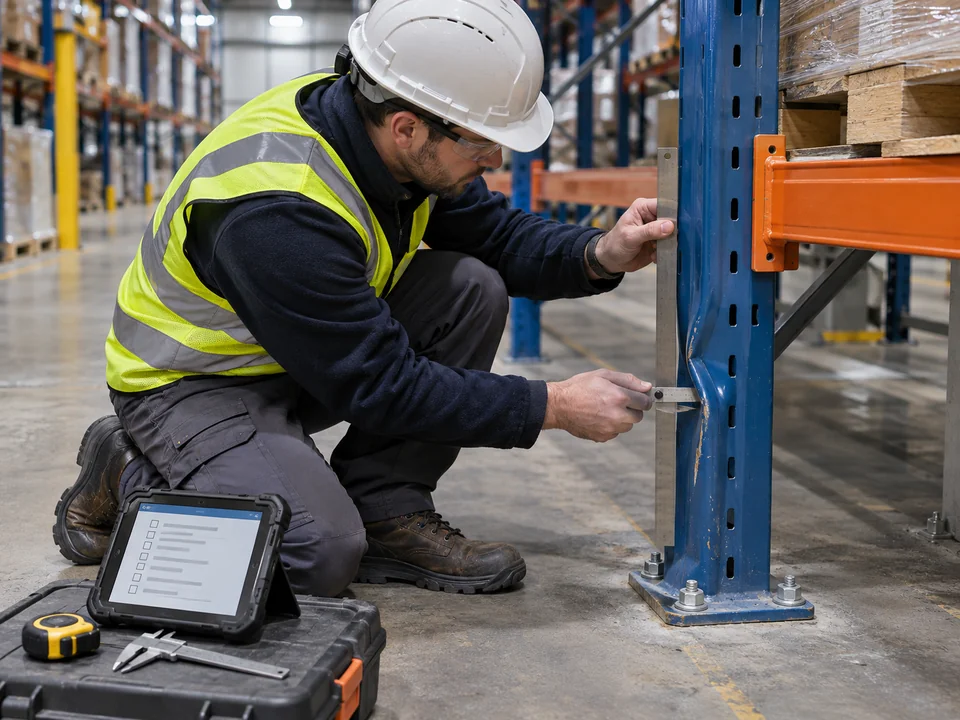
Dents, bends, twists, tears or splits — especially in the bottom few feet. Columns leaning out of plumb.
Base plates & anchors
Missing, loose or sheared anchors; bent base plates; cracked or spalled concrete; improvised shims.
Frame bracing
Bent, cut or missing horizontal and diagonal braces; cracked brace welds.
Beams & connectors
Bends, twists, sag beyond span/180 under load, cracked connector welds, deformed tabs, beams not fully seated.
Beam locks
Missing safety clips or bolts. Without them a beam can be knocked loose from below.
Loads & pallets
Overloads, broken pallets, off-center or overhanging loads, items stored in flue spaces.
Acceptable damage limits depend on the component and the manufacturer, and many inspectors use RMI's damage-assessment guidance. Do not straighten, heat or weld a damaged component on site without engineering approval (Cisco-Eagle).
Printable inspection checklist
Mark each box: ✓ = OK · A = action needed (note the bay below) · N/A. Any damaged upright, beam or anchor: unload and isolate the bay, then call a qualified person.
A. Documentation & signage
- Load plaques present, legible and matching the current beam levels
- Rack drawings / LARC drawings, permits and capacity charts on file
- Manufacturer and model of the rack identified
- Actions from the previous inspection closed out
B. Uprights & frames
- No dents, bends, twists, tears or splits in columns
- Columns plumb and straight (no more than 1/240 of height, about ½ in per 10 ft)
- Horizontal and diagonal braces present, straight, welds intact
- No field welding, cutting or drilled holes
- Column protectors and end-of-aisle guards intact and secured
C. Base plates, anchors & floor
- Every column anchored as designed; anchors tight, none missing or sheared
- Base plates flat and seated; shims only as specified by the manufacturer
- No cracked, spalled or settled concrete at base plates
D. Beams & connectors
- No bent, twisted or cracked beams
- Loaded beams not sagging beyond span ÷ 180 (e.g. 0.53 in on a 96 in beam)
- Connectors fully seated; no cracked welds or deformed tabs
- Beam locks / safety clips present at both ends of every beam
E. Loads & pallets
- No level or bay loaded beyond its plaque rating
- Pallets in good condition, centered, with even overhang front and back
- Loads stable and wrapped; nothing leaning against uprights
- Nothing stored on top of the rack or in aisles beyond the plan
F. Decking, supports & accessories
- Wire decks and pallet supports seated and undamaged
- Row spacers, backstops, netting and guards in place
- Aisle and location labels legible
G. Fire & life safety
- Flue spaces kept open as required by the fire code or permit
- Required clearance below sprinkler deflectors maintained
- In-rack sprinklers and guards undamaged (if fitted)
- Aisles, exits and fire equipment unobstructed
H. High-density systems (if present)
- Drive-in: rails, rail connectors and floor guide rails straight and secure
- Push-back: carts roll freely; stops and rails undamaged
- Pallet flow: rollers turn, brakes and separators work, no debris
General information only — follow your rack manufacturer's instructions, ANSI MH16.1 and local requirements. Source: www.rackingzone.com/guides/rack-inspection-checklist/
What to do when you find damage
- Unload and isolate. Take the load off the affected bays and the bays sharing damaged frames, and barricade or tag them so nobody reloads them. MH16.1 calls for the affected portion to be isolated.
- Report it. Make reporting impacts blame-free; hidden damage is the dangerous kind.
- Get a qualified assessment. A rack engineer or qualified inspector decides whether the component can stay, must be repaired, or must be replaced.
- Repair or replace with engineered parts. RMI recommends replacement over repair when the rack's manufacturer and model can be identified; engineered repair kits are an option when they are designed for the situation. Under MH16.1-2023, a registered design professional certifies the repair before the rack goes back into service.
- Fix the cause. Add column guards or end-of-aisle protection, review aisle widths and lighting, retrain operators, and update load plaques if anything changed.
- Record it. Log the damage, the decision and the repair with your inspection records.
If damage keeps coming back in the same places, it is usually a layout or traffic problem, not a rack problem. Ask for an inspection and RackingZone will arrange for suitable pre-screened inspectors or installers to contact you directly.
Frequently asked questions
The Rack Manufacturers Institute (RMI) recommends regularly scheduled inspections by a qualified person, at least annually, with more frequent checks where traffic, product velocity or past damage is high — and an immediate check after any forklift impact or seismic event. Many operations add daily visual checks and monthly internal inspections.
OSHA has no rack-specific standard and does not set a rack inspection interval. It can cite rack hazards under the General Duty Clause and its materials-storage rule (29 CFR 1910.176(b)), and industry standards such as ANSI MH16.1 and manufacturer instructions are used to show what a recognized hazard is.
RMI describes a qualified person familiar with storage rack design and installation requirements. In practice that is often a rack engineer, a registered professional engineer with rack experience, or an inspection firm. Under ANSI MH16.1-2023, a damaged rack goes back into service only after a registered design professional certifies it has been restored.
Sources
- Modern Materials Handling Don't Underestimate Rack Maintenance & Repair — RMI inspection guidance (Sep 2018)
- Damotech ANSI MH16.1-2023 excerpts (owner duties, damage, plumb limits, anchoring)
- Damotech When Should You Get Your Pallet Racks Inspected?
- OSHA 29 CFR 1910.176 — Handling materials, general
- J. J. Keller Storage rack safety: capacity, anchoring and stacking (2023)
- Cisco-Eagle Damaged Pallet Rack: Repair or Replace? (May 2023)
- ANSI Webstore ANSI MH16.1-2023 (official standard)
Last reviewed: Nov 2026 by RackingZone Editorial. Spotted an error or an outdated figure? Tell us.