California High-Piled Storage Permits, Explained
When storage over 12 feet triggers California Fire Code Chapter 32, what a permit application usually needs, and why the answer depends on your city.
This guide is general information, not engineering or legal advice. Requirements vary by jurisdiction and by manufacturer — confirm with a qualified engineer, your rack supplier and your local authority.
Key takeaways
- Under the California Fire Code (CFC), high-piled combustible storage means combustible storage where the top of storage is over 12 ft — and, where the fire code official requires it, over 6 ft for high-hazard commodities such as Group A plastics, rubber tires and idle pallets.
- Once a high-piled area exceeds 500 sq ft including aisles, the CFC calls for a fire permit, and the fire department reviews plans covering commodities, rack layout, flue spaces, sprinklers, access doors and smoke removal.
- The racks themselves usually need a separate building permit — many California jurisdictions start at 5 ft 9 in and require stamped structural and seismic calculations at about 8 ft. Thresholds vary by city.
- The 2025 CFC took effect on January 1, 2026, and cities and fire districts add local amendments. Always check your local fire authority's handout before you buy racks.
What counts as high-piled storage
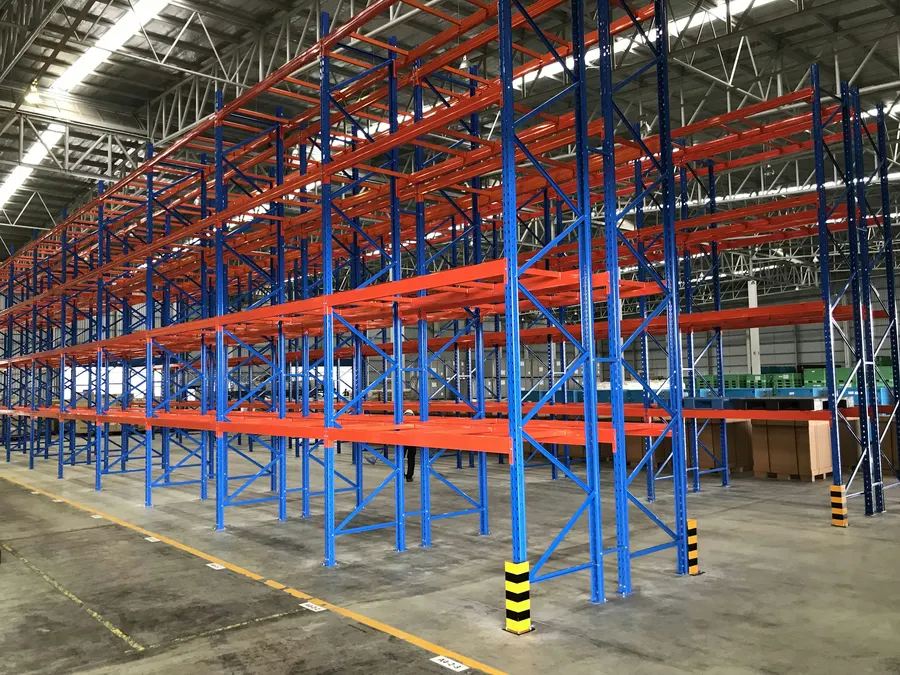
The California Fire Code is based on the International Fire Code, and its Chapter 32 regulates high-piled combustible storage. Quoting the 2025 CFC definition, the City of Fresno's April 2026 rack handout describes it as the "storage of combustible materials in closely packed piles or combustible materials on pallets, in racks or on shelves where the top of storage is greater than 12 feet in height," adding that, where required by the fire code official, it "also includes certain high-hazard commodities, such as rubber tires, Group A plastics, flammable liquids, idle pallets, and similar commodities, where the top of storage is greater than 6 feet in height" (City of Fresno).
Three details catch people out:
- It is the top of the goods, not the top of the rack. Chino Valley Fire District measures storage height "from the finished floor to the highest point of the commodity stored, not the highest shelf or tier level" (Chino Valley Fire District).
- "Combustible" includes packaging and pallets. Non-combustible products in cardboard or on wood pallets still count as combustible storage (Alameda County Fire Department bulletin).
- Aisles count toward the area. The 500 sq ft permit threshold includes aisles, so a few rows of racking can cross it quickly.
Commodity classification
Fire protection is designed around what you store. CFC Section 3203 sorts commodities into Classes I–IV and high-hazard, with separate rules for plastics (Groups A, B and C). A simplified version, adapted from Chino Valley Fire District's handout:
| Class | Typical description |
|---|---|
| Class I | Essentially non-combustible products on wood pallets |
| Class II | Class I products in slatted wood crates or heavy cardboard |
| Class III | Wood, paper, cloth, Group C plastics, or limited amounts of Group A/B plastics |
| Class IV | Class I–III products packaged in Group A or B plastics, or with free-flowing Group A plastics |
| High-hazard | More combustible than Class IV — for example many Group A plastics, rubber tires and flammable liquids |
Two points in the 2025 CFC are worth checking early: Table 3203.8 lists lithium-ion batteries (other than those installed in the equipment they power) as high-hazard, and Section 3203.10 raises the commodity class when goods sit on many types of plastic pallets unless the pallets are listed for equivalence (2025 CFC Chapter 32). Both can change the sprinkler design for an otherwise ordinary warehouse.
Which code edition applies
California adopts a new building standards code every three years. The California Building Standards Commission published the 2025 edition of Title 24 — which includes the Fire Code (Part 9) and the Building Code (Part 2) — on July 1, 2025, with an effective date of January 1, 2026 (California Building Standards Commission). The 2025 CFC adopts the 2024 International Fire Code with California amendments.
Cities, counties and fire districts can adopt local amendments, and their handouts are not always updated at the same time as the code. Some still reference earlier editions; LA County's January 2026 rack plan-review list, for example, cites the 2021 edition of the rack design standard while Fresno's April 2026 handout cites the 2023 edition (see local examples). Ask the reviewer which edition and which local amendments apply to your application, and check the date on any handout you rely on.
Two permits, two departments
Most projects deal with two separate reviews. They overlap, but they answer different questions.
| Fire permit (high-piled storage) | Building permit (storage racks) | |
|---|---|---|
| Issued by | Fire department or fire district (fire prevention / fire marshal) | City or county building & safety |
| Question asked | Can the building's fire protection handle this storage? | Will the racks, anchors and slab hold up, including in an earthquake? |
| Typical trigger | More than 500 sq ft of high-piled storage, including aisles | Often racks over 5 ft 9 in; engineering often required at 8 ft |
| Main documents | Storage plans, commodity classification, sprinkler design to NFPA 13 | Rack layout, structural and seismic calculations, anchorage details |
The fire permit
CFC Section 3201.2 points to the permit sections of Chapter 1. In the 2025 CFC, an operational permit is required to use a building or portion of one with more than 500 sq ft, including aisles, of high-piled combustible storage, and a construction permit is required to install or modify a structure with more than 500 sq ft of it (2025 CFC Sections 105.5 and 105.6). Local fire authorities set their own application forms and fees.
What the fire department will require depends on the size of the high-piled area and the commodity class. CFC Table 3206.2 steps up requirements at area breakpoints — for Class I–IV commodities at 500, 2,500, 12,000 and 500,000 sq ft; for high-hazard commodities at 500, 2,500 and 300,000 sq ft. Features that can be triggered include:
- Automatic sprinklers designed for the commodity, storage height and arrangement under NFPA 13 — existing ceiling sprinklers designed for a lower hazard may need upgrading, or in-rack sprinklers may be needed.
- Fire department access doors — under Section 3206.7.5, spaced no more than 125 ft apart center to center (200 ft allowed in some existing buildings).
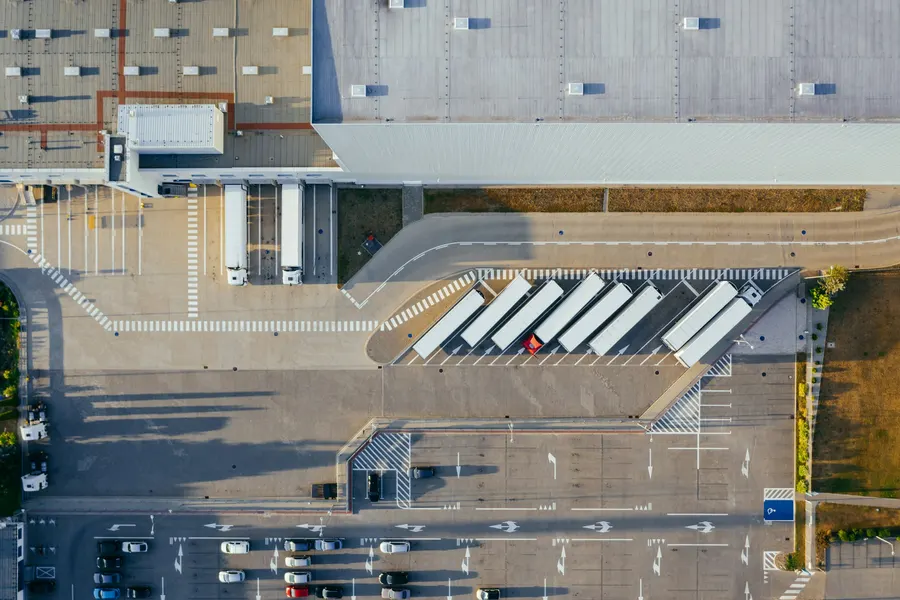
- Fire apparatus access roads within 150 ft of all portions of the exterior walls (Section 3206.6).
- Smoke and heat removal in accordance with CFC Section 910 (Section 3206.8).
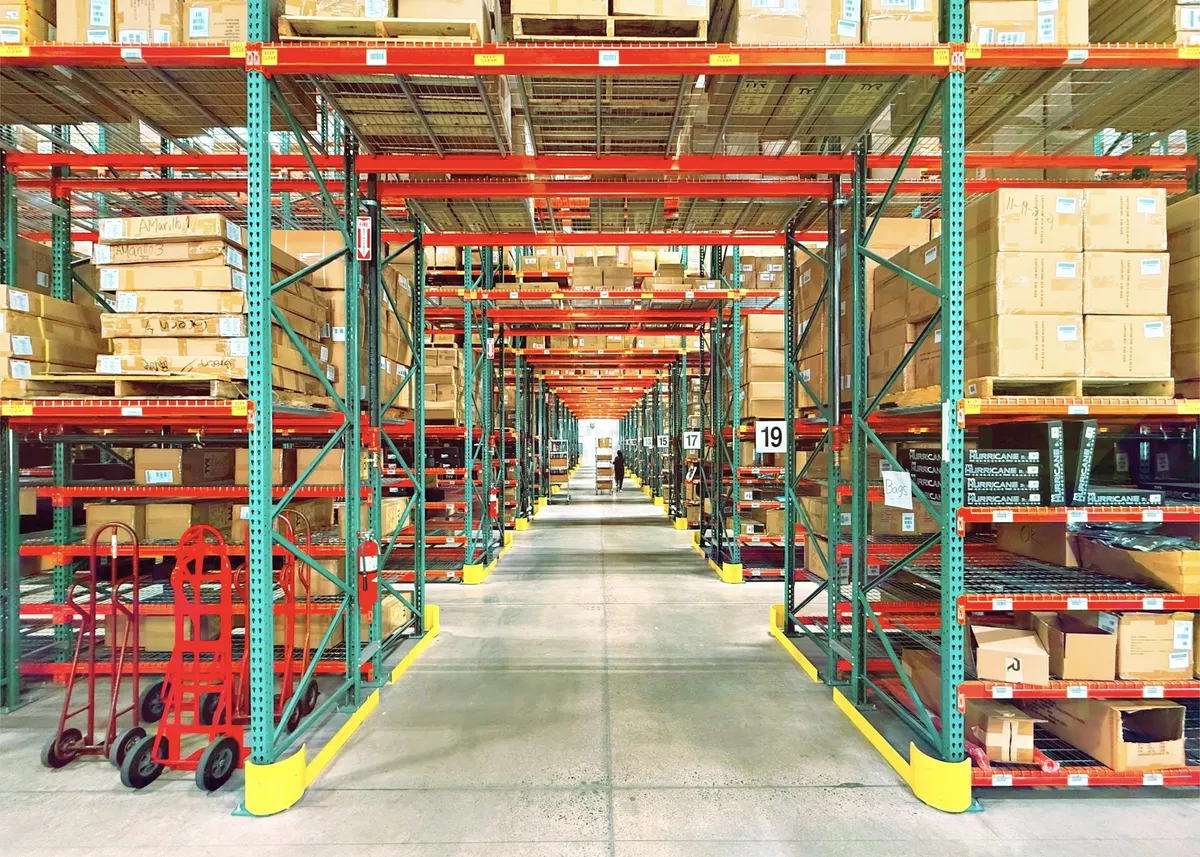
- Flue spaces in sprinklered rack storage (Section 3208.3). Table 3208.3 sets 3 in or 6 in transverse and longitudinal flues depending on single-, double- or multiple-row racks and storage height.
- Aisles — at least 44 in wide in sprinklered buildings, more in some cases (Section 3206.10.1.1).
Section numbers above are from the 2025 CFC (Chapter 32 via UpCodes); local amendments can add to them.
The building permit for the racks
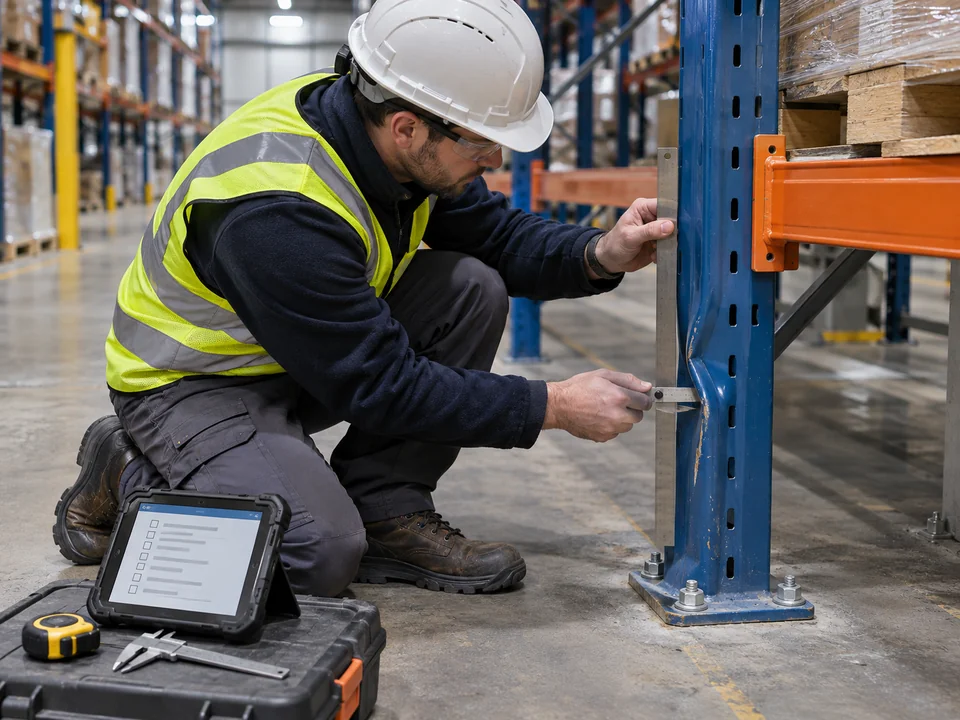
Steel storage racks are structures, and in California they are designed for seismic loads. Typical local thresholds:
- Los Angeles County requires building permits for storage racks over 5 ft 9 in, and structural plans, details and calculations by a California-licensed civil or structural engineer for racks 8 ft or taller (LA County DPW, Jan 2026).
- Fresno uses a table by height of the highest beam and height-to-depth ratio: no separate permit up to 5 ft 9 in, a permit and seismic anchorage details above that, and structural plans and calculations by a licensed engineer over 8 ft (City of Fresno, Apr 2026).
- Roseville requires a permit even for anchored, non-movable racks of 5 ft 9 in or less (City of Roseville, 2020).
What the plans need to show
CFC Section 3201.3 lists what high-piled storage plans must include. In the 2025 edition:
- Floor plan showing locations and dimensions of high-piled storage areas
- Usable storage height for each storage area
- Number of tiers within each rack, if applicable
- Commodity clearance between the top of storage and the sprinkler deflector for each storage arrangement
- Aisle dimensions between each storage array
- Maximum pile volume for each storage array
- Location and classification of commodities (Section 3203)
- Location of commodities that are banded or encapsulated
- Location of required fire department access doors
- Type of fire protection systems
- Location of valves controlling the water supply of ceiling and in-rack sprinklers
- Type, location and specifications of smoke removal and curtain board systems
- Dimension and location of transverse and longitudinal flue spaces
- Additional information the fire code official requires
Local fire authorities often ask for more. Chino Valley Fire District, for example, also wants a site plan with fire lanes, hydrants and Knox box locations; forklift battery-charging and LP-gas areas; an egress path analysis; sprinkler design criteria with references to the specific NFPA 13 sections; and, in an existing sprinklered building, the original design criteria from the hydraulic placard or approved plans, with a conclusion on whether upgrades are needed. It recommends that a consultant familiar with high-piled storage prepare the package.
Seismic anchorage and structural calculations
The building side is about structure. LA County's 2026 plan-review list shows what reviewers look for:
- Seismic design in accordance with ASCE 7-22 Section 15.5.3 or the RMI specification, with racks designed for the most critical load combinations.
- Floor plans showing every rack type, aisle widths and the exit path; drawings covering all permitted beam configurations.
- Calculations and drawings signed and stamped by a California-licensed civil or structural engineer or architect.
- Concrete anchors with a valid evaluation report, and periodic special inspection of anchorage for racks 8 ft or taller in Seismic Design Categories D, E or F.
- The engineer's verification of the existing slab, including cracks and nearby joints.
- A permanent load plaque of at least 50 sq in, and at least 18 in of clear space between the top of storage and the ceiling sprinkler deflectors.
Fresno's handout asks for rack layout details with tiers and weight limits per tier, anchorage details, and a note limiting out-of-plumb to 1/240 (1/2 in per 10 ft), citing ANSI MH16.1:2023. The design standard itself is explained in our ANSI MH16.1-2023 guide.
Local examples
A sample of what California jurisdictions publish. These are examples, not a complete list. Check that the version you use is current.
| Jurisdiction | Document | Notable points |
|---|---|---|
| Los Angeles County (unincorporated areas and contract cities) | Steel Storage Racks Plan Review List (Jan 2026) | Permit over 5 ft 9 in; engineer's calcs from 8 ft; high-piled racks over 12 ft need Fire Department approval before the building permit is issued |
| City of Fresno | Storage Racks Plan Submittal Guidelines (Apr 2026) | Cites the 2025 CBC, ASCE 7-22, ANSI MH16.1:2023 and MH16.3:2025; high-piled questions go to Fire Prevention |
| City of Brea (Orange County) | Storage Rack Permit Requirements (May 2025) | Permit over 5 ft 9 in; structural calcs from 8 ft; a separate Fire Department high-piled permit for racking over 12 ft |
| Chino Valley Fire District (San Bernardino County) | High Piled Storage Requirements | Operational permit over 500 sq ft including aisles; detailed plan list; signed worksheet; option to stay below the height or area limits |
| City of Roseville | Storage Racks and Shelves Guidelines (Apr 2020) | Anchored racks need a permit at any height; engineer's calcs over 8 ft |
Fire services in California are organized differently from building departments: a city may use a county fire department, a fire district or a joint powers authority. Find out who your fire authority is before you start; it is not always the city named on your address.
Planning the timeline
Review times depend on the jurisdiction, its workload and how complete the package is, so build time for at least one round of corrections. What tends to keep projects moving:
- Classify your commodities first. Packaging, plastics content and pallet type drive the sprinkler design. Get product data sheets together before anyone draws a rack.
- Check the existing sprinklers. Find the hydraulic placard or original approved plans. If the system cannot protect what you want to store at the height you want, that is usually the biggest cost and schedule item.
- Talk to the fire authority early. Many offer pre-application meetings or publish worksheets. Ask about local amendments and the edition they enforce.
- Order rack engineering with the quote. Ask the supplier to include stamped structural and seismic calculations and LARC drawings for your site, not just a load chart.
- Coordinate both submittals. In LA County, high-piled racks over 12 ft need Fire Department approval before the building permit is issued.
- Do not install or load before approval. Racks installed ahead of approval may have to be modified, and loading them can put you out of compliance.
- Keep it compliant. The CFC requires the approved plans to be kept on the premises. A change in commodity, storage height or layout can require a new review.
Checklist for owners and tenants
- Maximum top-of-storage height for each area (not just rack height)
- Commodity classification, including plastics content, packaging, lithium-ion batteries and pallet type
- High-piled area in sq ft, including aisles
- Existing sprinkler design criteria and water supply information
- Rack layout with aisle widths, flue spaces and exit paths
- Location of fire department access doors, smoke vents or mechanical smoke removal
- Stamped rack structural and seismic calculations, anchorage details and slab information
- Load plaque content for each rack type
- Which fire authority and building department you apply to, and which code edition they enforce
- Plan for keeping flue spaces, clearances and aisles clear after move-in
How RackingZone can help
Permit work usually involves the rack supplier, a structural engineer, a fire protection engineer or permit consultant, and an installer. See our pages on rack installation and rack inspection, seismic and permit support. Tell us about your project and RackingZone will arrange for suitable pre-screened suppliers to contact you directly. Already have racks? Our rack inspection checklist covers flue spaces and sprinkler clearance too.
Frequently asked questions
Under the California Fire Code, high-piled combustible storage is combustible material in closely packed piles, on pallets, in racks or on shelves where the top of storage is more than 12 ft high. Where the fire code official requires it, certain high-hazard commodities such as rubber tires, Group A plastics, flammable liquids and idle pallets count when stored over 6 ft. Height is measured to the top of the goods, not the top of the rack.
The California Fire Code calls for an operational permit to use more than 500 sq ft (including aisles) of high-piled combustible storage, and a construction permit to install or modify a structure with more than 500 sq ft of it. Your local fire authority issues the permits and may have local amendments, so check its handout.
Often, yes. Many building departments require a permit for storage racks over 5 ft 9 in and stamped structural and seismic calculations from about 8 ft — Los Angeles County, Fresno and Brea publish rules along these lines. Some cities require permits for anchored racks of any height. This is separate from the fire department high-piled permit.
California Fire Code Section 3201.3 lists the plan content: storage areas and heights, tiers, clearance to sprinkler deflectors, aisles, commodity classification, fire department access doors, fire protection systems and valves, smoke removal and curtain boards, and flue spaces. Fire authorities commonly add a site plan, sprinkler design criteria under NFPA 13 and an egress analysis.
The 2025 California Building Standards Code, including the Fire Code, took effect on January 1, 2026. Local jurisdictions can adopt amendments, and some handouts still reference older editions, so ask your fire authority which edition and amendments it enforces.
Sources
- California Building Standards Commission Codes — 2025 Title 24 published July 1, 2025, effective January 1, 2026
- UpCodes 2025 California Fire Code, Chapter 32: High-Piled Combustible Storage
- UpCodes 2025 California Fire Code, Chapter 1 (Sections 105.5 and 105.6, permits)
- County of Los Angeles DPW Steel Storage Racks Plan Review List (Ver 2, Jan 30, 2026)
- City of Fresno Storage Racks Plan Submittal Guidelines and Requirements (Apr 2, 2026)
- City of Brea Storage Rack Permit Requirements (May 2025)
- Chino Valley Fire District High Piled Storage Requirements
- City of Roseville Storage Racks and Shelves Guidelines (Apr 2020)
- Alameda County Fire Department How to Apply for a Permit for High-Piled Combustible Storage (bulletin, 2013)
- NFPA NFPA 13: Standard for the Installation of Sprinkler Systems
Last reviewed: Nov 2026 by RackingZone Editorial. Spotted an error or an outdated figure? Tell us.